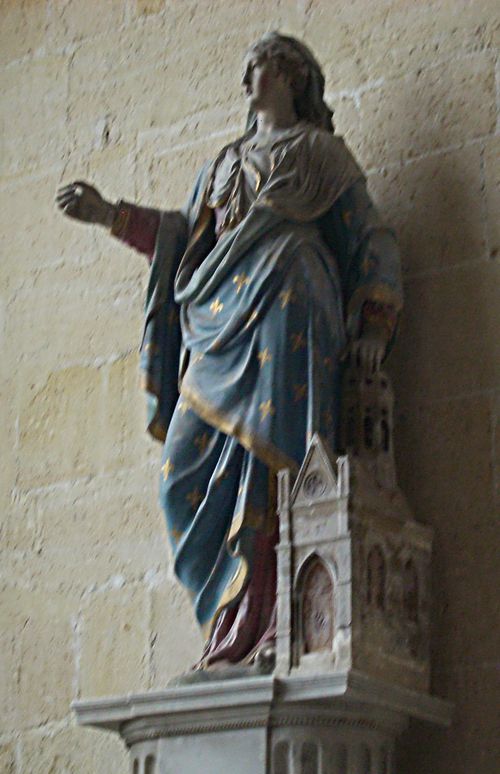
Showing posts with label Clotilda. Show all posts

Saturday, November 27, 2010

Epilogue: The Saintly Queen


Jane Tibbets Schulenburg (Forgetful of Their Sex) believed that Clotilda became the prototype for later Catholic queens and noblewomen. and Katherine Scherman (The Birth of France) wrote of Clotilda:

Her selfless dedication is the obverse side of the Merovingian nature…the pure and literal application of the teaching of the primitive Church. People like Clotild[a]…add a dimension of light, like the sun shining in back of a cloud, to the dismal and stormy climate of post-imperial Europe.


Of course, it must be remembered that Clotilda was, in fact, a Burgundian, not a Merovingian!

After the murders of her grandsons, Queen Clotilda lived a life of chastity and charity in Tours, though she still played a political role. She made many private donations. In Clermont, she gave a priest, named Anastasius, a gift of land and the title that proved his right to them. The Bishop of Clermont, Cautinus, sought to keep the lands for himself by dint of his authority, but Anastasius maintained his rights to the land, even after being tortured. Anastasius eventually escaped and complained to King Lothar, who upheld the legitimacy of Clotilda’s gift.

JoAnn McNamara and John E. Halborg in Sainted Women of the Dark Ages hypothesized that Clotilda went to Tours in the relatively newly acquired Aquitaine, where Clovis was commissioned as patrician of Rome, as "part of an ongoing Frankish policy of reaching a solid settlement with the old Gallo-Roman population." They also noted that female saints "regularly diminished the gains of their warrior relatives by almsgiving." This "suggests that they were playing a sort of structural role in the circulation of wealth, possibly as representatives of the more merciful or 'womanly' side of monarchy."

Clotilda also funded the building of many churches and monasteries and gave lands to support them. Among these was the Notre-Dame-des-Andelys, located along the Seine near Rouen. It was the last church she founded and around its founding and construction a story was circulated.

According to the story, the men working on the church requested of Clotilda that wine be provided to slake their thirst during the hot summer days. While she considered the request, a spring of fresh water was discovered nearby. In a dream, Clotilda was told that if the workers were to request wine again, that she should send a servant to take them some water from this newfound spring. When the request was so made, and the water delivered, the workers discovered that the water had turned to wine. They went to the queen and gave thanks. The queen gave credit to God for the miracle and asked none to reveal the miracle. The situation continued throughout the construction of the monastery, but only occurred for the workmen working on the structure. All others who drank the water tasted water. When the monastery was completed, the miracle ended and the spring returned to its natural state for one and all.

Clotilda did not totally remove herself from the lives of her sons, and perhaps her most famous miracle was associated with her concern for their welfare. According to Gregory, her son Childebert and step-grandson Theudebert were at war with her son Lothar, who had the weakest army of the three. He retreated to a forest near Caudebec in Normandy and entrenched himself and prayed for his safety. His mother also prayed for the intercession of St. Martin in hopes of averting another family tragedy. When Childebert came near Lothar’s position, a thunderstorm occurred, lightning flashed, the wind howled, and hailstones fell. Soldiers covered themselves with their shields and horses ran away. Meanwhile, those in Lothar’s camp heard nothing, all was quiet and no storm raged. Unnerved, Childebert and Theodebert begged for God’s mercy and retreated. Peace was made with Lothar and each returned to their own lands. Such was the nature of the intervention of St Martin, at the behest of Clotilda. Her prayers were said to have inspired St. Martin’s miracle.

She also seems to have rewarded some Burgundian religious men who had accompanied her to Clovis’ kingdom. In the years 520 and 521, she appointed three elderly men to be Bishops of Tours. Gregory of Tours wrote that Theodorus and Proculus, the tenth Bishops of Tours, had come with Clotilda from Burgundy as consecrated Bishops but "had been expelled from their cities because they had incurred hostility there." She appointed them jointly in early A.D. 520 when they were both old men and they led Tours for approximately two years before dying and being buried there. Dinifius, who had also come from Burgundy, succeeded to the Bishop’s office, also at the behest of Clotilda, in A.D. 521. She gave him property from the royal domain to do with as he wished. He gave most of it to his own cathedral and left the rest for "deserving people." He was only Bishop for ten months.

Clotilda died in Tours in 545 A.D. and was carried to Paris and buried by her sons Childebert and Lothar in Saint Peter’s church next to her husband Clovis. Gregory wrote:

Neither the royal status of her sons nor her worldly goods nor earthly ambition could bring her to disrepute. In all humility she moved forward to heavenly grace.


Clotilda, perhaps the brightest shining light of the Burgundians, served as a light in the darkness for the early barbarians. Through her, the first real king of the Franks was Christianized and secured the faith in Europe.

UP NEXT: Conclusion

SOURCES:
Schulenburg, Forgetful of Their Sex.
Scherman, The Birth of France.
Sainted Women of the Dark Ages, ed. and trans. JoAnn McNamara and John E. Halborg with E. Gordon Whatley (Durham, N.C.: Duke University Press, 1992).
Gregory of Tours, Historia Francorum, 4.12, in Kurth, Saint Clotilda.
Kurth, Saint Clotilda.
Vita Sanctae Chrotildis, c. XII, in Kurth, Saint Clotilda.
Gregory of Tours, The History of the Franks.

Tuesday, November 23, 2010

Gregory on Clotilda and her Sons--Documenting Historical Vengeance or Creating Political Propoganda?

Gregory placed the revenge of Clotilda at the center of the Frankish desire to conquer Burgundy. Yet, as has already been discussed, Clotilda may have had nothing to avenge. She probably arranged the original alliance between Clovis and Gundobad around A.D. 507. This act of diplomacy would be difficult to accept of a woman with vitriolic hatred for her uncle. Further, as Ian Wood explains (The Merovingian Kingdoms), if Clotilda had "waited from the A.D. 490s until A.D. 523 the feud cannot have been uppermost in her mind."

Herwig Wolfram (Germanic Peoples) noted that both the Franks and Theodoric’s Goths invaded Burgundy, claiming revenge as a reason "that may well have been intended merely to veil hard power politics." Godefroid Kurth (Saint Clotilda) offered another viable counterargument to Gregory’s account.

If Clotilda was so eager for vengeance why did she not urge the duty on her husband Clovis, and why did she wait for the death of [Gundobad] in order to vent her wrath upon the innocent son of the latter?

He supported his belief with the fact that when Clovis had Gundobad within his power at Vienne, he left the field. Even when Gundobad failed to send tribute the next year, Clovis did not go to war with him. Instead, he made an alliance, and, according to Kurth:

...all this under the very eyes of Clotilda just at the time of his own conversion to Christianity, when we may presume that his wife’s influences was most potent with him.


Given this, it seemed Clotilda, if she had wrongs to avenge, must have forgotten them until after both Clovis, her “natural avenger” and Gundobad were dead. Kurth again:

[I]t was only after both offender and offended had been in their graves the one during nine and the other during twelve years, and when there was nobody to punish, that we are asked to believe that this pious widow, living in retirement and devoting herself to good works, separated from her sons and peacefully awaiting death, suddenly bethought herself to crown a life filled with good works by initiating a fratricidal war in which her own flesh and blood were to perish.

On the other hand, while advocating for the strong role that medieval queens played in politics, Suzanne Fonay Wemple (Women in Frankish Society) made the interesting argument that since:

Loyalty to the uterine line was inculcated in aristocratic males in their early childhood...we should not be surprised to learn that Clotild[a] asked her sons, not her husband, to avenge the murder of her parents.


Danuta Shanzer and Ian Wood (Avitus of Vienne) remarked upon the duality between the supposed vengeance wrought upon the sons of Gundobad and Gregory's account of the supposed murder of Chilperic and his wife. In fact, they observed that Gregory reveals a remarkable penchant for fratricide and patricide among many of the Franks' rivals (Thuringians, Ostrogoths, Visigoths and Burgundians). Given this, repeated accusations of murder and mayhem "may...have been an aspect of Merovingian political propaganda." Revenge as a reason for war. To this I might add that it is a common tactic in politics to accuse your opponent of those things that you have or would do. Could Gregory have ascribed so many instances of inter-family murder in an attempt to portray such acts as commonplace, thus diminishing the horrendous crimes often committed by the ancestors of his own Merovingian patrons?

Some believed that the story was invented by popular imagination in an attempt to explain the reason that led two closely allied families to go to war. Accordingly, a connection was made by portraying the story of Gundobad’s murder of Chilperic and his wife first to justify the nearly identical form of Clotilda’s supposed revenge. Because Clodomir killed Sigismund and his wife, the legend grew that Chilperic’s wife, (Clotilda’s mother) was killed with him and both thrown in a well. Because Clodomir also killed Sigismund’s two remaining sons, then Gundobad was said to have killed Chilperic’s two sons (though these may have never actually existed).

As Wood explains:
There is also a curious parallel between the manner of [Chilperic II’s] death, supposedly by drowning in a well, and the similar disposal of Sigismund’s body after his defeat and capture in 524. It seems that Gregory’s account of the murder of Chilperic and the subsequent bloodfeud reflected later assumptions, rather than historical reality. The marriage of [Clotilda], therefore, may not have had the ominous implications which the bishop of Tours attributed it.

A parallel can be drawn in the similarity between Gregory’s account of Clovis’s battlefield conversion and that of Constantine roughly two hundred years earlier. Gregory was not above using one event as a template for another if he deemed it convenient or necessary. After all, Gregory and Fredegarius were Merovingian chroniclers and probably desired to show their patrons in the best light, often at the expense of historical truth.

Kurth speculated that this legend grew up out of the medieval mind, so to speak.

[There is a] universal tendency of the popular mind to explain great misfortunes as being the expiation of great crimes. When Sigismund, king of Burgundy, was killed with his wife and children by his cousin Clodomir, it was supposed that he must have perished in expiation of some similar crime which one of his ancestors had perpetrated against some member of Clodomir’s family. And hence it was easy to assume that [Gundobad] had inflicted on Chilperic, the grandfather of Clodomir, the same treatment as, at a later date, Clodomir had inflicted on his son.

[Of] the pretext on which the sons of Clovis took up arms against their unhappy cousin we have no information, nor indeed is the question of much historic importance. The war may have been caused simply by that insatiable love of fighting and of glory which lies at the root of uncivilised [sic] nature, or again by that desperate avarice which gave men no rest so long as there remained anything to covet or to conquer.


J.B. Bury summarized, "We can thus safely conclude that the true Gundobad was not the sanguinary tyrant of later tradition, nor was Clotilda the bearer of tragedy and doom to the Burgundian house as she appears in the story."

Don't bet on historical certainty, JB!

UP NEXT: Epilogue

SOURCES:

Wolfram, Germanic Peoples.
Kurth, Saint Clotilda.
Wemple, Women in Frankish Society.
Avitus of Vienne, Shanzer and Wood.
Kurth, “St. Clotilda,” in Catholic Encyclopedia, 1908 ed.
Wood, The Merovingian Kingdoms.
Bury, Invasion of Europe.

Friday, May 28, 2010

Clovis' Role in Stoking the Burgundian Civil War

Around A.D. 500, Gundobad and Godegisel ruled together in Burgundy, though Gundobad was probably the arch-king while Godegisel was his subordinate, probably ruling only the territory around Geneva more directly. The fate of their brother Godomar was not recorded. The cause of their rivalry is unknown, and it appears they had peacefully coexisted for some time.

That Godigisel was the aggressor in the event was evident. Perhaps sibling rivalry or Godigisel’s jealousy over the position and fame of his older brother, or resentment over the partitioning of the kingdom whereby Gundobad had received most of Chilperic I’s former lands, had prompted him to approach Clovis about an alliance against his brother. Clovis had been winning great victories against other barbarian tribes and Godegisel heard of these and sent ambassadors to him asking for aid in attacking Gundobad. In exchange, Godegisel offered tribute at a rate determined by Clovis.

Clovis accepted the offer, and there have been many theories as to why he did. Perhaps he did it simply based on loyalty to his wife’s former guardian. Godegisil had essentially been Clotilda’s foster father and may have been a Catholic himself (Godefroid Kurth, based on his reading of Pardessus, Diplomata, vol.I., observed, “We know at least that in conjunction with his wife Theodelinda, he built the monastery of St. Peter at Lyons.”).

Additionally, as Godigisel was less powerful than Gundobad, he was less of a threat to Clovis, who probably could not have easily passed up an opportunity to severely weaken, if not destroy, a dangerous rival. Some assumed that Clotilda, if forced to choose, probably would have sided with the uncle under whose care she had been given. Kurth, who wondered if, perhaps, Clotilda saw Clovis’s intervention as a chance to save Godigisel rather than to destroy Gundobad, wrote, "[b]ut, at the same time, while coming to the help of the one, she had no wish to make relentless war on the other.”

Similar to this, others have said that the simple fact of being related to the Burgundians was enough motivation for Clovis to get involved. J.M. Wallace-Hadrill (The Longhaired Kings) asserted that, “It was the fact of kinship, not of his wife’s Catholicism...Clovis marched into Burgundy at the invitation of one of his kinsmen by marriage, Godigisel, caring little where it might lead.”

Others contended that Clovis sought to kill Gundobad to avenge the murder of his wife’s parents, though he ultimately did not exact said revenge. And so we arrive at one of the great debates surrounding Clovis and the Burgundians. Was Clovis, and later his progeny, seeking revenge upon the Burgundians? Or was this a useful myth?

Edward James (The Franks) who theorized that though Clovis could have sought vengeance on behalf of his wife, “if he was a more cynical politician than Gregory allows,” then the story of Gundobad murdering Clotilda’s parents “served the Franks as useful propaganda for many years.” Katherine Scherman (The Birth of France) stated there was no direct evidence that Clotilda encouraged Clovis in his conquest of Burgundy because “the Christian bias of the chroniclers” saw the “motive of revenge” as “immoral.” Along the same line, Godefroid Kurth (Saint Clotilda) observed:

To a bloody-minded and barbarous people, in a state of spiritual infancy, how could Clotilda, the great and the good, lack any element necessary to their crude ideal; how could she be otherwise than vengeful, if vengeance were a point of honour, and if to forgive were weakness and cowardice? As surely as the mind of childhood has got its stereotyped king and queen and prince, ever crowned in high state and radiant with gold, so surely has the childlike multitude certain moulds into which every hero or saint must be pressed unless the public imagination is to be pained and shocked.


Some historians, such as Herwig Wolfram, at least partly attributed Clovis’s interest in the Burgundian civil war as a sort of thanks to his wife for helping to convert him, implying that Clovis thought it would be appropriate to fight Arians. Others have countered that, though the conversion of Clovis and his Franks helped him to consolidate power, there can be no doubt that had they been Arian, they would have still attacked the Burgundians and Visigoths because they were looking to expand no matter who was in their way.

Some believed that more earthly, and immediate, circumstances motivated Clovis. After Clovis had captured Soissons and all of her riches, he was aware that his warriors would expect continued success and booty. A civil war would have seemed a perfect opportunity to satisfy his warriors and this may point to the possibility that Clovis could have approached Godigisel about a joint attack on Gundobad.

UP NEXT: The Burgundian Civil War

SOURCES:
Wood, “Kings, Kingdoms and Consent"
Kurth, Saint Clotilda.
Wallace-Hadrill, The Long-Haired Kings.
James, The Franks.
Scherman, The Birth of France.
Wolfram, Germanic Peoples.
O’Sullivan and Burns, Medieval Europe.
Randers-Pehrson, Barbarians and Romans.

Saturday, May 1, 2010

Clotilda's Political Influence

In addition to the credit Clotilda has garnered for converting her pagan husband to Catholic Christianity, there are other arguments made on behalf of the influence wielded by Clotilda in the political arena. A strong queen could take advantage of the vague definition of her role in the early middle ages. Her presence at the royal court and position as mother to royal heirs gave her access to her husband, his advisers and the royal treasury. At the death of Clovis, Clotilda was probably a very politically influential figure in the kingdom, given the young age of her children and the attachments in court she had no doubt made, including the significant support of the Catholic bishops, such as Remigius.

She would need these contacts and their support, and possibly that of her Burgundian relatives, over the next few years. Clovis left behind four sons, but only three were sons of Clotilda. The eldest son, Theuderic, was much older than his half-brothers and even had a son of his own, Theudebert. He was probably in a politically strong position, with military victories and his own loyal warriors, and was a severe threat to the welfare of Clotilda and her sons. Assuming that a mother would be predisposed to guarantee the welfare of her children, it is plausible to propose that a political compromise was reached between she and Theuderic.

As well as church support, Clotilda may have also called on her relationship with her Burgundian relatives to add muscle to the negotiations. It seems doubtful that Theuderic could be checked solely by the officials of a religion to which he had but recently converted, if he did at all (there is no proof that he followed his father to the baptismal pool).

The bishops and the aristocrats were also probably instrumental in helping Clotilda to define the division of the Frankish kingdom amongst the sons of Clovis. Katharine Scherman (The Birth of France) believed that:

[Clotilda], in an attempt to foster harmony, designated as capitals of the four kingdoms cities in a near arc around Paris....Anticipating the predictable clashes of her hotheaded, only semicivilzed sons, it was likely that she was also the one who persuaded them to respect Paris as neutral territory.


Finally, evidence points to the land division of A.D. 511 between Clotilda’s sons and Theuderic as the first such splitting of inheritance. Ian Wood speculated:

"followed the lines of the old Roman civitas boundaries. The experts here were the bishops and the Gallo-Roman aristocracy. The division is inconceivable without their approval...but it seems plausible to suggest [that the division was a] political compromise [not] tradition.


Wood also argued further that Childebert and Chlothar would later have to make a similar compromise with their nephew Theudebert (son of Theuderic, and perhaps older than his uncles) who had the support of many within the kingdom. This seems to have created a “tradition” of land partition between heirs.

If this is so, what looks to us like Frankish tradition may only have been formed by the political compromises of the first half of the sixth century. One result of such a suggestion must be that in 511 [Clotilda] could not have been certain that her sons, young as they were, would survive.


Regardless of the particulars, it can be inferred that Clotilda's greatest political success was in preserving the birthright, and survival, of her sons.

UP NEXT: Clovis' Role in Stoking the Burgundian Civil War

SOURCES:
Ian Wood, “Kings, Kingdoms and Consent.”
Janet Nelson, “Queens as Jezebels: The careers of Brunhild and Balthild in Merovingian History,” in Medieval Women, ed. D. Baker (Oxford, 1978), 31-77, in Elisabeth van Houts, “The State of Research: Women in Medieval History and Literature,” Journal of Medieval History 20
Katharine Scherman, The Birth of France: Warriors, Bishops and Long-Haired Kings (New York: Random House, 1987).

Tuesday, April 27, 2010

Clotilda, Clovis and the Conversion

Godefroid Kurth (Saint Clotilda) believed that the relationship of Clovis and Clotilda must have encouraged marital fidelity. There is no evidence that Clovis begat any illegitimate offspring after their marriage. No illegitimate heir surfaced in the years of conflict between the sons of Clovis, which tends to support and confirm that Theuderic was Clovis’s only illegitimate son. Evidence of husbandly accommodation also is provided by his forbearance in allowing his sons to be baptized when there appeared to be no advantage to doing so.

Further, according to Kurth, she must have been comfortable with the relationship if she persistently attempted to sway him to Christianity. If their relationship was not so strong, would Clovis have continued to tolerate his wife’s persistent efforts at proselytizing him? Would Clotilda have felt comfortable in her cause if she had doubts as to the disposition of her husband’s feelings toward her? Writes Kurth: “It is obvious that she must have enjoyed considerable ascendancy over his mind in order to have repeatedly urged so great a sacrifice without fear of violent refusal.”

While there has been much written about Clovis’s battlefield epiphany, Clotilda undoubtedly laid the groundwork for his conversion. Championing Clotilda's primacy as the prime mover behind Clovis' conversion, Jane Tibbetts Schulenburg (Forgetful of Their Sex) writes, it’s “the ‘Christ of Clotilda’ whom Clovis invokes” and “neither St. [Remigius] nor other members of the official church hierarchy were similarly awarded this type of prominence.” In contrast, Wallace-Hadrill asserted that while Clovis showed goodwill to the Catholic bishops by his marriage to Clotilda, the acute act of his marriage to Clotilda did not prompt his conversion, despite the efforts of his wife and Bishop Remigius. However,Wallace-Hadrill was willing to concede that the groundwork laid by Clotilda and Remigius may have played a key part:

The pattern is familiar. Defeat stares him in the face and his gods have deserted him; his thoughts turn to his wife’s god, to whom he prays in his heart for victory; and victory is his. Like Constantine in a similar predicament, Clovis knows that he must throw in his lot with the new god...The parallel with the battle of the Milvian Bridge does not disprove the later story. His wife and St Remigius were there to remind Clovis of Constantine, if he needed reminding.


On the other hand, as I.N. Wood (The Merovingian Kingdoms) noted that Avitus made no mention of Clotilda’s role in converting Clovis, nor of a battlefield conversion, but credits Clovis for finding his own way.

Regardless of who deserves credit for converting the Frankish King, there was a risk for Clovis in deciding to convert. The majority of the Franks were pagan or Arian and for Clovis to maintain his power over the Franks, his bodyguard would also have agreed to convert or they would have disbanded and eliminated Clovis’s power base. Clovis had doubts as to whether they would join him and called a meeting to inform them of his intention. They all agreed to be converted with their king. Thus, around 3,000 of his warriors*, (though this may be an exaggerated number) were baptized with him.


Wallace-Hadrill theorized that Clovis’s conversion wasn’t “total” but more the acceptance of another god “to his people’s pantheon, perhaps in a commanding position.” Still, this is different than baptism and “officially” accepting no other gods but the Christian. This last was probably made easier by the “pantheon” of saints.

But even adhesion calls for conviction of right, and it is no belittlement of Clovis’ act to term it a political decision, taken after weighing Frankish pagan conservatism against the assured approval of the Gallo-Romans.

Perhaps the Gallo-Roman episcopate had finally demanded conversion, or Clovis had thought that the Empire would actively support him against the Goths. Finally, as Wallace-Hadrill points out, “Without Tolbiac [the battle with the Alamans], the proof would have been lacking that the Christian god gave victory over other Germans.” Tolbiac was, to use a contemporary term, the tipping point.


*Kurth believed that the average Frank cared not what the religion of his ruler was, but this was not so for the bodyguard, which was “bound to the king by a pledge of honour, was associated in all his acts and shared in his good and evil forturnes…they shared in all his personal interests, in his friendships and enmities, and his Gods were their Gods. What would become of this intimate communion of views and sentiments when Clovis passed from the service of Wodin to the service of Christ?”


UP NEXT: Clotilda's Political Influence

SOURCES:

Godefroid Kurth, Saint Clotilda.
Jane Tibbetts Schulenburg, Forgetful of Their Sex.
J.M. Wallace-Hadrill, The Long-Haired Kings.
Ian Wood, The Merovingian Kingdoms.
Justine Davis Randers-Pehrson, Barbarians and Romans.
J.B. Bury, Invasion of Europe.
Samuel Dill, Roman Society.
Jeremiah O’Sullivan and John F. Burns, Medieval Europe (New York: F.S. Crofts & Co., 1943).

Tuesday, April 13, 2010

Doubting Gregory of Tours: "All that was best known of the life of Clotilda was that which never really occurred."

Gregory of Tours' account of the marriage of Clovis and Clotilda portrayed the Burgundian King Gundobad (and Clotilda's uncle) in an unflattering light. Yet, the truth may have been different than that put forth by the Merovingian propagandist and the debate regarding the credibility of Gregory's account has encompassed nearly as many years as did the duration of the short-lived second Burgundian Kingdom in Gaul!

Most historians from the time of Gibbon to the turn of the 20th century seem to have taken Gregory's stories at face value. However, some historians--like Godefroid Kurth, who was an early skeptic (relatively speaking) of the Gregory account--have questioned some of Gregory's tales. Kurth examined Gregory’s own sources and concluded that Gregory relied too much on legend, which he uncritically used to fill in gaps in his historical record. Another, later, historian--I.N. Wood--remarked that:

the account of fifth-century Gaul offered by Gregory in his Histories is intended, on the one hand, to denigrate the Arian Goths and Burgundians, and, on the other, to elevate the Franks and their king, the Catholic convert, Clovis.


J.M. Wallace-Hadrill unequivocally stated that Gregory’s hero is Clovis, and Gregory placed Clovis’ conversion too early to make it appear as if all of Clovis’ great deeds were done as a Catholic. (Wallace-Hadrill’s chapter, “The Work of Gregory of Tours in the Light of Modern Research,” in The Long-Haired Kings, is informative on the subject Gregory’s work, point of view and motivation). Ian Wood also urges us to take Gregory with a grain of salt:

Gregory’s account of Clovis seems to be more concerned to create the image of a catholic king against whom his successors could be assessed, than with any desire to provide an accurate account of the reign. In order to understand Clovis within the context of the late fifth and early sixth centuries it is necessary to emphasize the contemporary evidence, and to treat Gregory, as far as possible, as a secondary source.


Despite these warnings, many have continued to uncritically accept Gregory's account of Clotilda and the events surrounding her while she lived in Burgundy.

That Clovis probably married her in the early 490’s and that she was the niece of King Gundobad is accepted, but that is about it. Some historians have contended that the story, or legend, of Gundobad’s murder of Chilperic II and Clotilda’s subsequent desire for revenge grew up about a generation after the marriage of Clovis and Clotilda.

Skeptics of the widespread acceptance if Gregory's tale as historical fact have relied on a textual criticism of both Gregory and the Fredegarius account as well as other sources that mention Clotilda, especially the Saint’s Lives. They have contended, to quote Kurth, that the story of Gundobad murdering Chilperic II threw “a shadow over the character of Clotilda [ie; her later supposed desire for revenge upon her uncle, Gundobad], and a still darker shadow over the character of King Gundobad” and maintained that the “the very basis of [the story] is entirely fictitious.”

Some skeptics have held that Clotilda had no reason to avenge her father’s death by Gundobad because Gundobad didn’t commit the murders. They cited as proof a letter written by Bishop Avitus of Vienne to console Gundobad on the death of a daughter. Within this letter, Avitus wrote that, “[i]n the past, with ineffable tender-heartedness, you mourned the deaths of your brothers.” Accordingly, the brother mentioned was not Godegisil who later fought Gundobad and died, so it must have referred to Chilperic II. Another alternative may have been that the unnamed brother was the mysterious Godomar, who was barely mentioned in the sources and is but a name listed along with Gundobad and his Burgundian brothers.

Thus, skeptics contend, Avitus’ letter seems to absolve Gundobad of the murder of Chilperic II. Herwig Wolfram noted that, “It is likely that both Godomar and Chilperic II—the father of Clotild[a], the future wife of Clovis—died natural deaths around 490.” J.B. Bury also expressed doubts that Gundobad murdered his brother and explained that Gregory was engaged in a bit of medieval "retcon" (my term, not Prof. Bury's!).

Bury says that the legend of a vengeful Clotilda “originated sometime after the great war of A.D. 523 between the Burgundians and the Franks.” This is the year that Gundobad's son and heir Sigismund and his family perished at the hands of Clovis' and Clotilda' sons by being thrown down a well. As such, to explain the reason that two closely allied families would go to war, a story was invented by, as Bury put it, "popular imagination" to help explain why saintly Clotilda would allow her sons to kill their kinsmen. So the story of old wrongs was created and the connection is made by portraying the old wrong to have been nearly identical to the form of revenge perpetrated.

Because King Sigismund and his wife were killed and thrown in a well, the legend grew that the same happened to Chilperic. Because Sigismund’s two sons were killed, then two sons of Chilperic--sons who may have never actually existed--were said to have been killed by Gundobad. Bury contended that "we can thus safely conclude that the true Gundobad was not the sanguinary tyrant of later tradition, nor was Clotilda the bearer of tragedy and doom to the Burgundian house as she appears in the story."

Justine Davis Randers-Pehrson has explained some of the historiographical problems with Gregory's story of Clovis, in general. First is the chronological problem, “which is wellnigh hopeless.” It has been the subject of scholarly debate for decades. “What confidence can be placed in judgments that sometimes must be based on the tense of a verb in a manuscript corrupted by copyists whose knowledge of Latin was admittedly faulty?” The second problem is on the primary source, Gregory of Tours. He “was a honest man, but he was possessed with a burning desire to prove that Clovis, from a very early time in his extraordinary career, had been the champion of true Christianity.” She also noted that most agree Gregory placed Clovis’s conversion too early so that all of his campaigns would be deemed victories for the Church. The third problem is the anachronistic belief that Clovis sought to create a French nation. “In reality," Randers-Pehrson writes, "if we read closely, he was a greedy opportunist who seized upon whatever chances arose in the flux of any given critical situation.” The first two problems seem viable while the last may be a bit too cynical for most.

While Kurth relies heavily on Saints Lives to poke holes in Gregory's accounts, others are wary. In Forgetful of Their Sex, author Jane Tibbetts Schulenburg warned that, while hagiography often provided the only source of information for medieval women, it is important to note that most hagiographers were less historians than saint propagandists. This does not necessarily exclude Saints Lives as valuable historical sources, she continued, but historians must be aware of the motivation of the hagiographer. Schulenburg is far more accepting of Gregory's account, which she used to conclude that Clotilda was a woman who was active in determining her own destiny:
Considering that Gundobad had killed her parents and exiled her sister, and continued to espouse Arianism, Clotilda was no doubt anxious to escape from his court and to start a new life.

Ian Wood and J.M. Wallace-Hadrill were also wary of the accounts in the Saints Lives and, despite their misgivings about Gregory, were willing to accept much of his tale concerning Clotilda and her vengeance. In his description of Clotilda urging her sons to attack Gundobad’s as part of a “blood feud,” Wallace-Hadrill notes that, “Some historians look upon the story as essentially a myth. I do not know why.”

For his part, Kurth believed that both Fredegarus and the monk of St Denis, who wrote the Liber Historiae, were even less critical of their sources than Gregory. Kurth also offered a defense of the hagiographers when he wrote:

[O]n this occasion at least hagiography can defend the legitimacy of its traditions in the name of science, while on the other hand we have the amusing spectacle of rationalistic learning, engaged in angry argument against the conclusions of the critical methods. Can it be true that in the estimation of certain historians the legends which glorify the saints are the only ones to be struck out, while those that calumniate them are to be preserved with pious care?

Regardless of this lively ongoing debate, the political factors that influenced the marriage are obvious. There appear to have been two factions in the kingdom of Burgundy; one that favored an alliance with the Franks, led by Godegisel, and another that mistrusted such an alliance, led by Gundobad. Clotilda had been living at Geneva*, the capital of her uncle Godegisel, who made a secret pact with Clovis. Thus, that Clotilda was Catholic was known to Clovis beforehand and was probably considered to be a desirable condition.

“Pious intrigue” was probably partly influential in matching a Catholic princess with the king of the pagan Franks. Since the Burgundians were known Arians, as were all of the other barbarian tribes, was it a coincidence that Clovis chose a Catholic Burgundian princess from this particular tribe?

However, though the Burgundians were Arian, they also seemed more tolerant of their Catholic subjects than the Vandals and Visigoths, and some of Gundobad’s closest advisors, such as Patiens and Avitus, were Catholic bishops. Though he may have not yet been Christian himself, it is probable that Clovis realized the political benefits of having a Catholic wife, especially one related to, at the time, a strong Arian kingdom that was also sympathetic to Catholics. The Burgundians also realized the importance of political marriages, as when Gundobad married his son to Theoderic’s daughter. For Clovis though, a marriage to Clotilda was more important for the ties it would strengthen to the dominant Roman Catholic Church than with those of the Burgundian kingdom.

Whether Gregory’s or Fredegarius’s accounts of Clotilda’s flight from the Burgundian kingdom to meet her betrothed are believable or not, what has been generally accepted is that the marriage was arranged at Chalon-sur-Saone and that Clovis met her at Villery, south of Troyes, and accompanied her to Soissons for the wedding. As Kurth explained, a poem written describing the ceremony replaced the historical facts as the historical record.

In this way legend at an early date took the place of historical fact, and, during many centuries, all that was best known of the life of Clotilda was that which never really occurred.


* Though, as I've already noted, Gregory's story of Clotilda's engagement and betrothal to Clovis implies Clotilda is at Gundobad's court (which is in Lyons), not Geneva.

UP NEXT: Clotilda, Clovis and the Conversion

SOURCES:

Avitus of Vienne, Shanzer and Wood.
Gregory of Tours, The History of the Franks.
Fredegarius, Chronicle of Fredegar.
Godefroid Kurth, Saint Clotilda.
I.N. Wood, “Continuity or calamity?: the constraints of literary models,” in Fifth-century Gaul: a crisis of identity?, ed. Drinkwater and Elton.
J.M. Wallace-Hadrill, The Long-Haired Kings.
Ian Wood, The Merovingian Kingdoms.
Kurth, “St. Clotilda,” in Catholic Encyclopedia, 1908 ed.
Justine Davis Randers-Pehrson, Barbarians and Romans.
J.B. Bury, Invasion of Europe.
Jane Tibbetts Schulenburg, Forgetful of Their Sex: Female Sanctity and Society ca. 500-1100.
Herwig Wolfram, Germanic Peoples.

Friday, March 26, 2010

The Marriage of Clovis and Clotilda: The Story

According to Gregory of Tours, Clovis had envoys in Burgundy who reported back to him about the beautiful and intelligent princess Clotilda. He sent messengers to Gundobad and asked for her hand in marriage. Afraid to refuse the wishes of a powerful, neighboring king, Gundobad acceded and entrusted Clotilda to Clovis’ envoys. They took her back to Clovis, who was pleased by the sight of Clotilda and married her.

The Fredegarius account is more detailed, though not necessarily more accurate. According to this version of the story, Clotilda and her sister were doing charitable work and were secluded and hidden from Clovis’ men. Eventually, Clovis sent a trusted Roman retainer named Aurelian, disguised as a beggar, to find Clotilda. Once Aurelian found her, he gave her Clovis’ ring as a show of faith.

Clotilda was overjoyed and gave Aurelian her own ring to return to Clovis, telling him to have Clovis ask Gundobad for permission to marry her. She urged haste for fear that a counselor to her uncle, Aridius, would arrive from Constantinople and dissuade Gundobad from allowing the marriage. Gundobad, apparently afraid of Frankish power, agreed to the union and Clovis and Clotilda were formally betrothed at Chalon, in A.D. 493.

Clotilda began her journey to her new kingdom in a treasure-filled carriage guarded by Frank warriors. While traveling, she heard that Aridius had returned to Gundobad’s court. Fearing pursuit, she ordered the Franks to put her on horseback to speed her travel.

Meanwhile, according to this account, Aridius had warned Gundobad of the peril of a marriage between Clovis and Clotilda, claiming she might prevail upon him to avenge the death of her father and brothers, which had been ordered by Gundobad. Gundobad sent a party of Burgundian warriors to abduct Clotilda, but her foresight had saved her and she had already reached the border of the Frankish kingdom. Once safe, she ordered the surrounding countryside to be ravaged by her escort and then gave thanks to God because her revenge upon Gundobad had begun.

As an addendum, based on a close reading of Avitus of Vienne's Epistula 5, Danuta Shanzer and Ian Wood theorize that:

[A]t some point, probably after his return to power in 500, [Gundobad] may have proposed a marriage between his own daughter and Clovis. Her death, however, which is recorded by Avitus, may well have led to the substitution of Gundobad’s niece, [Clotilda], the daughter of [Chilperic] , as a bride for the Frankish king.


UP NEXT: Doubting Gregory of Tours: "All that was best known of the life of Clotilda was that which never really occurred."

SOURCES:

Avitus of Vienne, Shanzer and Wood.
Gregory of Tours, The History of the Franks.
Fredegarius, Chronicle of Fredegar.

Wednesday, February 10, 2010

Young Clotilda

Chilperic II’s daughter Clotilda was born at Lyons around A.D. 474. She had a younger sister named Sedeluba, or Chrona, and both were educated as Christians, probably under the guidance their mother, who was most likely Roman Catholic. The court of Chilperic II was probably frequented by many Catholic bishops and other luminaries, including Sidonius, who was a regular visitor, as well as the Catholic bishops Avitus of Vienne and Patiens of Lyons. The girls were also probably familiar with the saints of Lyons, such as the slave martyr Saint Blandina.

That Clotilda was surrounded by such religious personages as Avitus and Patiens lends credence to the theory that she was undoubtedly much influenced by them in the faith. Thus, it is widely accepted that Clotilda’s mother, and perhaps her father, were Catholic. Clotilda’s mother was mentioned by Sidonius who sang her praises (as mentioned previously) and compared her to Tanaquil and Agrippina. As Godefroid Kurth elaborates (Saint Clotilda, 20-21), “each of which recalls the influence exercised by a noble-hearted woman over her husband.” Kurth also explained that while Sidonius was “addicted to hyperbole,” the compliments he gave to the wife of Chilperic II were probably not those of a cloying sycophant. “Sidonius had no affection for the Burgundians, and did not owe allegiance to Chilperic.”

Chilperic II probably died around A.D. 490 and, according to Gregory of Tours, his daughters were supposedly sent to the court of Godegisil in Geneva when Gundobad took the throne at Lyons.* If this is so, it is likely that Chilperic II was the eldest, and when he died, Gundobad assumed the throne as the preeminent king among his remaining brothers.

The death of Chilperic II, as described by Gregory of Tours, has spawned a debate among historians that has filled volumes. According to Gregory, “Gundobad killed his brother Chilperic and drowned Chilperic’s wife after tying a stone round her neck. He drove Chilperic’s two daughters into exile: the elder, whose name was Chroma, became a religious, and the younger was called Clotild[a].” (Some believe that the sisters went to Geneva because Godegisil was Catholic, while Gundobad was an Arian). This is the first example of how Gregory is, as Edward James (The Origins of France, 23) puts it, "on the whole hostile to Gundobad."

In Geneva, we are told that Clotilda became a pious Christian and she and her sister performed charitable deeds. According to Fredegarius, Sedeluba founded the Church of St Victor in the outskirts of Geneva and disappeared from the pages of history. Clotilda was also pious--she was said to have washed the feet of the poor--however, unlike her sister, Clotilda had a still larger role to play in Merovingian history.

=========================

* While it's not impossible to imagine Clotilda shuttling between the courts of her uncles in Geneva and Lyons, as will be discussed in the future, Gregory's story of Clotilda's engagement and betrothal to Clovis implies Clotilda is at Gundobad's court (which is in Lyons), not Geneva.**

** Incidentally, I'm not even sure if "court" is the proper term for whatever you called the place from which the Burgundian (and other barbarian) kings managed their holdings.

UP NEXT: Marriage of Clovis and Clotilda

SOURCES:

Godefroid Kurth, Saint Clotilda, trans. V.M. Crawford with a preface by G. Tyrell (London: Duckworth & Co., 1898).
Avitus of Vienne, Shanzer and Wood.
Gregory of Tours, The History of the Franks.
James, The Origins of France.
Fredegarius, Chronicle of Fredegar.