Showing posts with label J.M. Wallace-Hadrill. Show all posts

Tuesday, April 27, 2010

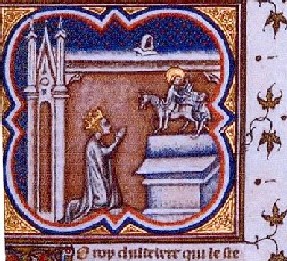
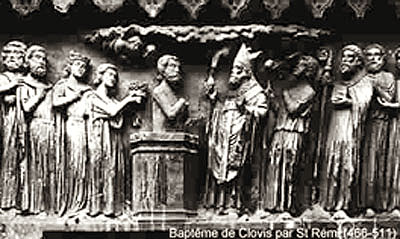
Clotilda, Clovis and the Conversion

Godefroid Kurth (Saint Clotilda) believed that the relationship of Clovis and Clotilda must have encouraged marital fidelity. There is no evidence that Clovis begat any illegitimate offspring after their marriage. No illegitimate heir surfaced in the years of conflict between the sons of Clovis, which tends to support and confirm that Theuderic was Clovis’s only illegitimate son. Evidence of husbandly accommodation also is provided by his forbearance in allowing his sons to be baptized when there appeared to be no advantage to doing so.

Further, according to Kurth, she must have been comfortable with the relationship if she persistently attempted to sway him to Christianity. If their relationship was not so strong, would Clovis have continued to tolerate his wife’s persistent efforts at proselytizing him? Would Clotilda have felt comfortable in her cause if she had doubts as to the disposition of her husband’s feelings toward her? Writes Kurth: “It is obvious that she must have enjoyed considerable ascendancy over his mind in order to have repeatedly urged so great a sacrifice without fear of violent refusal.”

While there has been much written about Clovis’s battlefield epiphany, Clotilda undoubtedly laid the groundwork for his conversion. Championing Clotilda's primacy as the prime mover behind Clovis' conversion, Jane Tibbetts Schulenburg (Forgetful of Their Sex) writes, it’s “the ‘Christ of Clotilda’ whom Clovis invokes” and “neither St. [Remigius] nor other members of the official church hierarchy were similarly awarded this type of prominence.” In contrast, Wallace-Hadrill asserted that while Clovis showed goodwill to the Catholic bishops by his marriage to Clotilda, the acute act of his marriage to Clotilda did not prompt his conversion, despite the efforts of his wife and Bishop Remigius. However,Wallace-Hadrill was willing to concede that the groundwork laid by Clotilda and Remigius may have played a key part:

The pattern is familiar. Defeat stares him in the face and his gods have deserted him; his thoughts turn to his wife’s god, to whom he prays in his heart for victory; and victory is his. Like Constantine in a similar predicament, Clovis knows that he must throw in his lot with the new god...The parallel with the battle of the Milvian Bridge does not disprove the later story. His wife and St Remigius were there to remind Clovis of Constantine, if he needed reminding.


On the other hand, as I.N. Wood (The Merovingian Kingdoms) noted that Avitus made no mention of Clotilda’s role in converting Clovis, nor of a battlefield conversion, but credits Clovis for finding his own way.

Regardless of who deserves credit for converting the Frankish King, there was a risk for Clovis in deciding to convert. The majority of the Franks were pagan or Arian and for Clovis to maintain his power over the Franks, his bodyguard would also have agreed to convert or they would have disbanded and eliminated Clovis’s power base. Clovis had doubts as to whether they would join him and called a meeting to inform them of his intention. They all agreed to be converted with their king. Thus, around 3,000 of his warriors*, (though this may be an exaggerated number) were baptized with him.


Wallace-Hadrill theorized that Clovis’s conversion wasn’t “total” but more the acceptance of another god “to his people’s pantheon, perhaps in a commanding position.” Still, this is different than baptism and “officially” accepting no other gods but the Christian. This last was probably made easier by the “pantheon” of saints.

But even adhesion calls for conviction of right, and it is no belittlement of Clovis’ act to term it a political decision, taken after weighing Frankish pagan conservatism against the assured approval of the Gallo-Romans.

Perhaps the Gallo-Roman episcopate had finally demanded conversion, or Clovis had thought that the Empire would actively support him against the Goths. Finally, as Wallace-Hadrill points out, “Without Tolbiac [the battle with the Alamans], the proof would have been lacking that the Christian god gave victory over other Germans.” Tolbiac was, to use a contemporary term, the tipping point.


*Kurth believed that the average Frank cared not what the religion of his ruler was, but this was not so for the bodyguard, which was “bound to the king by a pledge of honour, was associated in all his acts and shared in his good and evil forturnes…they shared in all his personal interests, in his friendships and enmities, and his Gods were their Gods. What would become of this intimate communion of views and sentiments when Clovis passed from the service of Wodin to the service of Christ?”


UP NEXT: Clotilda's Political Influence

SOURCES:

Godefroid Kurth, Saint Clotilda.
Jane Tibbetts Schulenburg, Forgetful of Their Sex.
J.M. Wallace-Hadrill, The Long-Haired Kings.
Ian Wood, The Merovingian Kingdoms.
Justine Davis Randers-Pehrson, Barbarians and Romans.
J.B. Bury, Invasion of Europe.
Samuel Dill, Roman Society.
Jeremiah O’Sullivan and John F. Burns, Medieval Europe (New York: F.S. Crofts & Co., 1943).

Tuesday, April 13, 2010

Doubting Gregory of Tours: "All that was best known of the life of Clotilda was that which never really occurred."

Gregory of Tours' account of the marriage of Clovis and Clotilda portrayed the Burgundian King Gundobad (and Clotilda's uncle) in an unflattering light. Yet, the truth may have been different than that put forth by the Merovingian propagandist and the debate regarding the credibility of Gregory's account has encompassed nearly as many years as did the duration of the short-lived second Burgundian Kingdom in Gaul!

Most historians from the time of Gibbon to the turn of the 20th century seem to have taken Gregory's stories at face value. However, some historians--like Godefroid Kurth, who was an early skeptic (relatively speaking) of the Gregory account--have questioned some of Gregory's tales. Kurth examined Gregory’s own sources and concluded that Gregory relied too much on legend, which he uncritically used to fill in gaps in his historical record. Another, later, historian--I.N. Wood--remarked that:

the account of fifth-century Gaul offered by Gregory in his Histories is intended, on the one hand, to denigrate the Arian Goths and Burgundians, and, on the other, to elevate the Franks and their king, the Catholic convert, Clovis.


J.M. Wallace-Hadrill unequivocally stated that Gregory’s hero is Clovis, and Gregory placed Clovis’ conversion too early to make it appear as if all of Clovis’ great deeds were done as a Catholic. (Wallace-Hadrill’s chapter, “The Work of Gregory of Tours in the Light of Modern Research,” in The Long-Haired Kings, is informative on the subject Gregory’s work, point of view and motivation). Ian Wood also urges us to take Gregory with a grain of salt:

Gregory’s account of Clovis seems to be more concerned to create the image of a catholic king against whom his successors could be assessed, than with any desire to provide an accurate account of the reign. In order to understand Clovis within the context of the late fifth and early sixth centuries it is necessary to emphasize the contemporary evidence, and to treat Gregory, as far as possible, as a secondary source.


Despite these warnings, many have continued to uncritically accept Gregory's account of Clotilda and the events surrounding her while she lived in Burgundy.

That Clovis probably married her in the early 490’s and that she was the niece of King Gundobad is accepted, but that is about it. Some historians have contended that the story, or legend, of Gundobad’s murder of Chilperic II and Clotilda’s subsequent desire for revenge grew up about a generation after the marriage of Clovis and Clotilda.

Skeptics of the widespread acceptance if Gregory's tale as historical fact have relied on a textual criticism of both Gregory and the Fredegarius account as well as other sources that mention Clotilda, especially the Saint’s Lives. They have contended, to quote Kurth, that the story of Gundobad murdering Chilperic II threw “a shadow over the character of Clotilda [ie; her later supposed desire for revenge upon her uncle, Gundobad], and a still darker shadow over the character of King Gundobad” and maintained that the “the very basis of [the story] is entirely fictitious.”

Some skeptics have held that Clotilda had no reason to avenge her father’s death by Gundobad because Gundobad didn’t commit the murders. They cited as proof a letter written by Bishop Avitus of Vienne to console Gundobad on the death of a daughter. Within this letter, Avitus wrote that, “[i]n the past, with ineffable tender-heartedness, you mourned the deaths of your brothers.” Accordingly, the brother mentioned was not Godegisil who later fought Gundobad and died, so it must have referred to Chilperic II. Another alternative may have been that the unnamed brother was the mysterious Godomar, who was barely mentioned in the sources and is but a name listed along with Gundobad and his Burgundian brothers.

Thus, skeptics contend, Avitus’ letter seems to absolve Gundobad of the murder of Chilperic II. Herwig Wolfram noted that, “It is likely that both Godomar and Chilperic II—the father of Clotild[a], the future wife of Clovis—died natural deaths around 490.” J.B. Bury also expressed doubts that Gundobad murdered his brother and explained that Gregory was engaged in a bit of medieval "retcon" (my term, not Prof. Bury's!).

Bury says that the legend of a vengeful Clotilda “originated sometime after the great war of A.D. 523 between the Burgundians and the Franks.” This is the year that Gundobad's son and heir Sigismund and his family perished at the hands of Clovis' and Clotilda' sons by being thrown down a well. As such, to explain the reason that two closely allied families would go to war, a story was invented by, as Bury put it, "popular imagination" to help explain why saintly Clotilda would allow her sons to kill their kinsmen. So the story of old wrongs was created and the connection is made by portraying the old wrong to have been nearly identical to the form of revenge perpetrated.

Because King Sigismund and his wife were killed and thrown in a well, the legend grew that the same happened to Chilperic. Because Sigismund’s two sons were killed, then two sons of Chilperic--sons who may have never actually existed--were said to have been killed by Gundobad. Bury contended that "we can thus safely conclude that the true Gundobad was not the sanguinary tyrant of later tradition, nor was Clotilda the bearer of tragedy and doom to the Burgundian house as she appears in the story."

Justine Davis Randers-Pehrson has explained some of the historiographical problems with Gregory's story of Clovis, in general. First is the chronological problem, “which is wellnigh hopeless.” It has been the subject of scholarly debate for decades. “What confidence can be placed in judgments that sometimes must be based on the tense of a verb in a manuscript corrupted by copyists whose knowledge of Latin was admittedly faulty?” The second problem is on the primary source, Gregory of Tours. He “was a honest man, but he was possessed with a burning desire to prove that Clovis, from a very early time in his extraordinary career, had been the champion of true Christianity.” She also noted that most agree Gregory placed Clovis’s conversion too early so that all of his campaigns would be deemed victories for the Church. The third problem is the anachronistic belief that Clovis sought to create a French nation. “In reality," Randers-Pehrson writes, "if we read closely, he was a greedy opportunist who seized upon whatever chances arose in the flux of any given critical situation.” The first two problems seem viable while the last may be a bit too cynical for most.

While Kurth relies heavily on Saints Lives to poke holes in Gregory's accounts, others are wary. In Forgetful of Their Sex, author Jane Tibbetts Schulenburg warned that, while hagiography often provided the only source of information for medieval women, it is important to note that most hagiographers were less historians than saint propagandists. This does not necessarily exclude Saints Lives as valuable historical sources, she continued, but historians must be aware of the motivation of the hagiographer. Schulenburg is far more accepting of Gregory's account, which she used to conclude that Clotilda was a woman who was active in determining her own destiny:
Considering that Gundobad had killed her parents and exiled her sister, and continued to espouse Arianism, Clotilda was no doubt anxious to escape from his court and to start a new life.

Ian Wood and J.M. Wallace-Hadrill were also wary of the accounts in the Saints Lives and, despite their misgivings about Gregory, were willing to accept much of his tale concerning Clotilda and her vengeance. In his description of Clotilda urging her sons to attack Gundobad’s as part of a “blood feud,” Wallace-Hadrill notes that, “Some historians look upon the story as essentially a myth. I do not know why.”

For his part, Kurth believed that both Fredegarus and the monk of St Denis, who wrote the Liber Historiae, were even less critical of their sources than Gregory. Kurth also offered a defense of the hagiographers when he wrote:

[O]n this occasion at least hagiography can defend the legitimacy of its traditions in the name of science, while on the other hand we have the amusing spectacle of rationalistic learning, engaged in angry argument against the conclusions of the critical methods. Can it be true that in the estimation of certain historians the legends which glorify the saints are the only ones to be struck out, while those that calumniate them are to be preserved with pious care?

Regardless of this lively ongoing debate, the political factors that influenced the marriage are obvious. There appear to have been two factions in the kingdom of Burgundy; one that favored an alliance with the Franks, led by Godegisel, and another that mistrusted such an alliance, led by Gundobad. Clotilda had been living at Geneva*, the capital of her uncle Godegisel, who made a secret pact with Clovis. Thus, that Clotilda was Catholic was known to Clovis beforehand and was probably considered to be a desirable condition.

“Pious intrigue” was probably partly influential in matching a Catholic princess with the king of the pagan Franks. Since the Burgundians were known Arians, as were all of the other barbarian tribes, was it a coincidence that Clovis chose a Catholic Burgundian princess from this particular tribe?

However, though the Burgundians were Arian, they also seemed more tolerant of their Catholic subjects than the Vandals and Visigoths, and some of Gundobad’s closest advisors, such as Patiens and Avitus, were Catholic bishops. Though he may have not yet been Christian himself, it is probable that Clovis realized the political benefits of having a Catholic wife, especially one related to, at the time, a strong Arian kingdom that was also sympathetic to Catholics. The Burgundians also realized the importance of political marriages, as when Gundobad married his son to Theoderic’s daughter. For Clovis though, a marriage to Clotilda was more important for the ties it would strengthen to the dominant Roman Catholic Church than with those of the Burgundian kingdom.

Whether Gregory’s or Fredegarius’s accounts of Clotilda’s flight from the Burgundian kingdom to meet her betrothed are believable or not, what has been generally accepted is that the marriage was arranged at Chalon-sur-Saone and that Clovis met her at Villery, south of Troyes, and accompanied her to Soissons for the wedding. As Kurth explained, a poem written describing the ceremony replaced the historical facts as the historical record.

In this way legend at an early date took the place of historical fact, and, during many centuries, all that was best known of the life of Clotilda was that which never really occurred.


* Though, as I've already noted, Gregory's story of Clotilda's engagement and betrothal to Clovis implies Clotilda is at Gundobad's court (which is in Lyons), not Geneva.

UP NEXT: Clotilda, Clovis and the Conversion

SOURCES:

Avitus of Vienne, Shanzer and Wood.
Gregory of Tours, The History of the Franks.
Fredegarius, Chronicle of Fredegar.
Godefroid Kurth, Saint Clotilda.
I.N. Wood, “Continuity or calamity?: the constraints of literary models,” in Fifth-century Gaul: a crisis of identity?, ed. Drinkwater and Elton.
J.M. Wallace-Hadrill, The Long-Haired Kings.
Ian Wood, The Merovingian Kingdoms.
Kurth, “St. Clotilda,” in Catholic Encyclopedia, 1908 ed.
Justine Davis Randers-Pehrson, Barbarians and Romans.
J.B. Bury, Invasion of Europe.
Jane Tibbetts Schulenburg, Forgetful of Their Sex: Female Sanctity and Society ca. 500-1100.
Herwig Wolfram, Germanic Peoples.

Wednesday, August 26, 2009

Founding the Second Burgundian Kingdom

In the Gallic Chronicle of 452, under the year A.D. 443, it is written “Sapaudia was given to the remnants of the Burgundians to be divided with the native inhabitants.” Though their first kingdom ended in catastrophic failure, the Burgundians survived. For the twenty years between the fall of the first Burgundian kingdom and the re-settlement in Sapaudia, no Burgundian King has been identified, but in A.D. 456 Gundioc was first mentioned. He may have been related to Gundahar, though he probably was the scion of a minor line of the Burgundians. It was also possible that he may have been related to the Goths as stories of the mid-sixth century said that Gundioc was a descendant of the old Goth king Athanaric.

The region called Sapaudia covered land that now comprises present-day eastern Switzerland and the southern portion of the Jura Mountains, near Geneva. It is generally believed that Aetius settled the Burgundians in Sapaudia in A.D. 443 because he intended that they serve as a buffer between the Romans of southern Gaul and the traditional Burgundian rivals, the Alamanni, who wanted to expand into the region. However, others have found it hard to believe that Aetius would have placed the recently defeated, and thus severely weakened, Burgundians in such a strategic position.

Even if the Burgundians were not severely weakened, it is doubtful that a brilliant tactician such as Aetius would have placed a strong and resentful Burgundian tribe in a strategic position. Thus, instead of the Alamanni, the problem Aetius hoped to solve by placing the Burgundians as he did was probably the rebellious Bacaudae and their allies in Gaul. Aetius had settled the Visigoths in Aquitania to quell a similar uprising at about the same time. Given this, the Burgundians, though still weakened by their encounter with Aetius and the Huns, were of sufficient strength to deal effectively with a peasant and slave uprising.

The relationship of the Bishop Hilary of Arles and Aetius has also been proposed by Georg Langgartner as a reason for the relocation of the Burgundians to Sapaudia. Hilary enjoyed widespread ecclesiastical support in the region, with a strong base centered at Lerins. He also had strong secular support outside of his own province. One of his strongest proponents was Aetius, who could have moved the Burgundians to Sapaudia to protect Hilary while he was at Besancon. This latter theory does not necessarily exclude the possibility that the Burgundians were placed in the region to quell a rebellion. Taken together, both may offer a more plausible scenario than that of a weakened people being placed in a key defensive position within the empire.

There are other theories. Some believed the Burgundians were too unsophisticated to realize they were being played as dupes by Aetius. The earlier Burgundian support for Jovinus has been cited as proof for this contention, which asserts that the Burgundians were too naïve in imperial politics to realize that they were being rebellious against Rome. Accordingly, the Burgundians applied a kind of circular logic whereby their support of Jovinus legitimized his imperial claim which in term legitimized their support. Thus, with the precedent of a Burgundian collective of circular logicians established, some historians have suggested that Aetius cleverly placed these “loyal if naïve barbarians” in an area that needed to be protected while simultaneously implying to the Gallic aristocrats that these same barbarians may be manipulated or agree with them on a grander plan for Gauls’ place within the empire.

Another, perhaps more likely reason, was that Aetius realized the benefit of having the allegiance and obligations, guaranteed under foederati status, of a group of barbarians who knew what it meant to face the Huns. Perhaps Aetius realized that the Huns were getting too powerful and were a potential problem with whom he would soon have to deal. The Burgundians were only one of a few key alliances he made to vouchsafe against an eventual loss of the control of his Hunnish mercenaries. On the Burgundian’s part, the desire to ingratiate themselves with Rome also cannot be discounted, thus they may have not been so much naïve as having few other options.

Finally, perhaps J.M. Wallace-Hadrill offered perhaps the most measured (if contrarian) opinion that no one knew precisely why the Burgundians were settled in “Savoy” by Aetius in A.D. 443. As he points out, Savoy didn’t seem to be in any danger of internal uprising and the Alamans were possibly too far away to pose an immediate threat.

Whether the Burgundians were settled to perform their duties as garrison troops, constables, or bodyguards, they were eventually called upon by Aetius to provide warriors for military action in other regions of Gaul. In A.D. 451, a faction of Burgundians followed Aetius and Theodoric, king of the Visigoths, when they faced Attila and his Huns and allies on the Catalaunian Plains, near the city of Troyes. Another faction of Burgundians joined Attila.

Attila’s Burgundians were from among those that still lived on the eastern shore of the Rhine and were part of the Hun army that entered the Belgic provinces, took Metz on April 7, 451, and pillaged and burned many other cities. These Burgundians were probably those who had split from the main body during the Vandal assault of A.D. 406. They were also those whom had purportedly turned to Christianity after defeating the Hun Uptar, but later must have been defeated and integrated into the Hunnic horde. The opposing Burgundians illustrates that Germanic tribes didn’t operate in the classically believed mono-ethnic manner. Germans prioritized booty and strength over racial or social loyalty. (Wolfram theorizes that this group seems to have slowly dispersed after the defeat of Attila, and some of them eventually found their way to the kingdom of their tribesmen along the Rhone).

Aetius’ tactic of pitting one Germanic tribe against another, while often successful, resulted in serious repercussions for the Roman Empire. The Empire’s policy of employing barbarians as mercenaries resulted in the gradual consolidation of military power into the hands of various barbarian generals. Roman rulers had concluded that it was safer to have foreign defenders in lieu of Roman armies because foreign chiefs were excluded by their nationality from having a legitimate claim on the throne. They attracted these chiefs by settling their people on Roman lands and extracting a pledge that they and their people would protect Rome from foreign invaders.

The specific nature of the Roman practice of providing land, or some other form of payment, to barbarians in return for their service as defenders has been much debated by historians. All agree that the Roman legal concept called hospitalitas played a role in this mixing of Germans and Romans within a province, but there has been disagreement over the specific characteristics of this system.

The system of hospitalitas was used to settle the Burgundians in their new kingdom of Sapaudia in A.D. 443. Earlier historians believed that Rome gave one-third to two-thirds of the Roman landowners’ estates, including the people on them, to the Germanic troops billeted there. More recent studies, particularly the work of Walter Goffart, have argued that, while there was probably a system of land allotment, this evolved into a system of tax revenue transfer. According to this theory, the Burgundians, and other Germanic tribes, were actually given a fixed portion of taxes assessed on land held by Romans rather than a portion of the actual land thus occupied. Finally, this transfer of tax revenue was made easier because the collection and distribution stayed in the hands of the Roman municipal office holders, the curiales, and did not fall to the barbarians themselves.

Over the years, the Burgundian king gave royal gifts and every loyal Burgundian retainer gained land to go with their share of the tax revenue, if they had not received land already. This informal system turned the Burgundians into landowners. Further, in a series of trade-offs with Roman landowners, they consolidated and centralized their estates, as did the Romans, and a system of Burgundian/Roman land ownership evolved.

Goffart has argued that these results caused confusion in later historical analysis as they were taken to be the form of the original design rather than the evolved result. Additionally, the system of tax reapportionment made sense because settled Barbarian troops did not cost anymore to the taxpayers than Roman troops. According to C.D. Gordon, the “dignity and eminence” of the existing aristocracies and clergy were not adversely affected by the presence of these barbarians.

[W]hen they finally occupied the Roman lands of the west, they had reached a state of civilization which enabled them to appreciate and to make some effort to preserve the civilization they had taken over. This is to be credited in large measure to the subsidies they had received for so long.


The acute instinct of the vastly outnumbered Burgundians to be inoffensive to the Gallo-Romans probably helped them gain the acceptance of their more tenured neighbors. Some historians believe that the Gallo-Romans even welcomed any Germans as a new source of manpower to till Roman lands, or that, specifically in the Burgundians case, that old memories of joining together in support of Jovinus had eased the way for sharing Roman lands.

There were barbarians within the Roman Empire prior to the “invasions,” mostly former or current members of the Roman army or prisoners and their descendants who had been used to repopulate militarily devastated regions. It has also been determined that the Burgundians modified their military unit structure to include Gallo-Romans within the ranks. As such, military, and later political, command, originally in the hands of chiefs or strong warriors who led comitatus, fell to the counts, or comes, of both Romans and Burgundians.

While the Burgundians attempted to smooth relations between their tribe and their Gallo-Roman neighbors, they also took proactive steps to maintain their own tribal unity within their new kingdom. They prescribed common laws and fostered a “common sense of identity” among their Germanic population while at the same time they tried to segregate between the Germans and the Roman or Gallo-Roman people who made up the majority of their new lands. Part of this Germanic unification process was accomplished by kings associating themselves with heroes of often mythical royal families or, at the very least, storied families from the history of their people, as did the Burgundian kings by associating themselves with the Gibechungs (or Nibelungs).

Most of the German tribes used religion as a unifying element and most, including the Burgundians, were Arian, a heretical Christianity that became a sort of cultural unifier, particularly as it became identified with the members of the royal families. The Burgundians also established law codes that drew from both traditional Germanic codes and probably some “local vulgar” Roman law traditions. Unfortunately, while these actions and beliefs were true for the free men who fought for their king, the opinions and thoughts of the peasants and slaves will probably never be known.

Up Next: Expansion

SOURCES:

Chronicle of 452, in Murray, Merovingian Gaul.
Wolfram, Germanic Peoples.
Musset, Germanic Invasions.
Edward James, The Origins of France: From Clovis to the Capetians, 500-1000 (New York: St. Martin’s Press, 1982).
Anthony King, Roman Gaul and Germany (Berkeley: University of California Press, 1990).
E.A. Thompson, “The Settlement of the Barbarians in Southern Gaul,” The Journal of Roman Studies 46, parts 1 and 2 (1956).
Justine Davis Randers-Pehrson, Barbarians and Romans: The Birth Struggle of Europe, A.D. 400-700 (Norman: University of Oklahoma Press, 1983).
J.M. Wallace-Hadrill, The Long-Haired Kings and other studies in Frankish History (New York: Barnes & Noble, Inc., 1962).
Mathisen, Ecclesiastical Factionalism.
Heinzelmann, Bischofsherrschaft in Gallien: Zur Kontinuitat romischer Fuhrungsschichten von 4. Bis zum 7. Jahrhundert (Munich, 1976) in Mathisen, Ecclesiastical Factionalism
Georg Langgartner, Die Galliepolitik der Papste im 5. Und 6. Jahrhundert. Eine Studie uber den apostolische Vikariat von Arles (Bonn, 1964) in Mathisen, Ecclesiastical Factionalism.
Jordanes, Goths.
Bury, Invasion of Europe.
C. Delisle Burns, “Christianity and the First Europe,” in The Barbarian Invasions: Catalyst of a New Order, ed. Katherine Fischer Drew (New York: Holt, Rinehart and Winston, 1970).
Collins, Early Medieval Europe.
Goffart, Barbarians and Romans.
Geary, The Myth of Nations.
Goffart, “Rome, Constantinople, and the Barbarians.”
Gordon, “Subsidies in Roman Imperial Defence,”
James, The Origins of France.