Saturday, February 20, 2010

Carnivalesque 59 (Ancient/Medieval)

Welcome to the 59th edition of Carnivalesque!!! This is an Ancient/Medieval version. Without further ado, onto the links.....


Ancient

Duane Smith at Abnormal Interests continues going over Akkadian prayers (on stone tablets) and is in a speculative mood.

N.S. Gill's Ancient History Blog discusses mythological explanations for athletic contests (like the Olympics). Turns out it had to do with memorializing: adversaries, rivals and even a python.

Mike Anderson's Ancient History
looks at the great civilizations of antiquity. Sounds like a topic worthy of debate.

Bill Caraher at the Archaeology of the Mediterranian World has some thoughts on digitized archeological notebooks and their values as (re)sources all their own.

Mary Harrsch at Roman Times wonders whether or not the new Starz series "Spartacus: Blood and Sand" will "resurrect old stereotypes."

Phil Harland at Religions of the Ancient Mediterranean looks at an instance where the Ephesian branch of the “Worldwide Dionysiac Performers” guild--an ancient version of the Screen Actors Guild, if you will--honored a benefactor.

LacusCurtius & Livius continues its series on Common Errors About Antiquity with #29 - Roman Chronology.

The Cultivated Classicist (Matthew Rogan) looks at the controversy surrounding ownership of the "Victorious Youth" and asks, "Where do artifacts belong?". "[S]cholarship should have no national boundaries" and institutions shouldn't be punished for the sins of the past. For all the latest controversies, check out Looting matters.

Medieval

Melissa's Medieval History Blog reports the discovery of the Byzantine road that validates the accuracy of the Madaba map. Medieval News reports on the uncovering of a 1,400 year old Byzantine wine press in Israel. Hmmm. Looks we've now got directions to a great place to party, old-style.

Adrian Murdoch at Bread and Circuses takes a look at some recent books covering Late Antiquity.

Jeff Sypeck at Quid Plura has been obsessed with gargoyles lately.

Muhlberger's Early History summarizes the medieval lawsuit over a coat of arms (Scrope vs. Grosvenor) and discovers Google Books has digitized one of the two volumes required to read up on the case.

Derek Olson at Homiliaria crawled through the e-codices virtual Manuscript Library of Switzerland "to find what sort of homilies and homiliaries it had hiding in it", especially those related to St. Gall. Success! (And he made a list).

Jared at Antiquitopia says Saint Augustine has a lot to say about, well, a lot...including the reason for the male nipple.

Richard Nokes at Unlocked Wordhoard directs us to this piece by K.A. Laity explaining that it was Geoffrey Chaucer who got the ball rolling with the whole Valentine's Day thing. Generations of men thank thee, Geoff. (But I still think Hallmark will remain the recipient of the biggest piece of the blame pie!)

'Scripts and Pics

Michael Drout at Wormtalk and Slugspeak updates us on his "Crazy Sheep DNA from Medieval Manuscripts Project". While there was some human contamination, the news ain't all baaaaaaaad and progress is continuing.

I don't know about you, but I rely on others to read and interpret the chicken-scratch on dead animal hides, so paleographers are pretty important. Jonathan Jarrett provides an update on the status of the Paleography Chair at King's College London. He's impressed by the effort to save the seat, but says it's too early to be fist-bumping and slapping hi-fives.

Without paleography, how could people like Carl Pyrdum at Got Medieval ever explain the significance of this manuscript drawing depicting a nun picking some "twigs and berries" (above, right).

Art historians also can provide some valuable insight and Kirsten Ataoguz at Early Medieval Art discusses Art History's mission and importance.

Medieval Geek attended a Rare Books School and took a bunch of pictures. Bibliophile heaven!

Fun


Heroic Dreams is always a fun place to stop if you're looking for ancient or medieval themed projects, like making a Spartan shield, a diorama of a castle under siege, or a tennis ball trebuchet. (No guarantees that the latter will help with your game).

Brian Murphy at the Cimmerian continues his series "Blogging the Silmarillion" and explains the links between Tolkien and Heavy Metal.

Finally, Studies of Popular Culture and the Middle Ages is always a good place to go if your looking for a mix of serious and whimsical medieval(ish) entertainment .

======================

Floggings and Flagellations

Now, for something completely different....You see, when I tallied up ALL of the submissions I received for this edition of Carnivalesque--from email, snail mail, phone, tweet, pager, smoke signals, braille--the sheer volume equates to....0, zip, nada. So if you ain't represented, blame yerself.

Back in the day, when I hosted the 10th and 62nd History Carnival (over at my old place), I had actual submissions to go along with my own scavenging. Sure, there was much more excitement in the early days with these new-fangled Carnivals and whatnot, but even ol' #62 saw some self-starters sending me a hint or two!

The thing about these carnivals is that they rely on bloggers with knowledge of the subject to submit posts: relying solely on the host or the Mistresses of Misrule to do all the work (I've been guilty of that too--Pie Jesu Domine. Dona Eis Requiem) can result in a very limited selection. They're only as good as we all make them. I hope I've managed to do my part this time around and I encourage everyone to give this a shot at least once! Finally, as always, thanks to Mistresses for keeping this particular carnival afloat....though, I suppose that could be taken in this context to mean it continues to fail the trial by drowning...

Wednesday, February 10, 2010

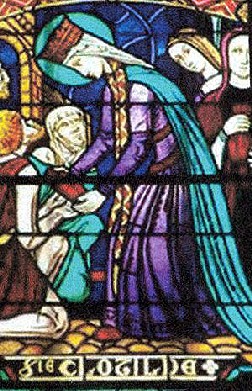
Young Clotilda

Chilperic II’s daughter Clotilda was born at Lyons around A.D. 474. She had a younger sister named Sedeluba, or Chrona, and both were educated as Christians, probably under the guidance their mother, who was most likely Roman Catholic. The court of Chilperic II was probably frequented by many Catholic bishops and other luminaries, including Sidonius, who was a regular visitor, as well as the Catholic bishops Avitus of Vienne and Patiens of Lyons. The girls were also probably familiar with the saints of Lyons, such as the slave martyr Saint Blandina.

That Clotilda was surrounded by such religious personages as Avitus and Patiens lends credence to the theory that she was undoubtedly much influenced by them in the faith. Thus, it is widely accepted that Clotilda’s mother, and perhaps her father, were Catholic. Clotilda’s mother was mentioned by Sidonius who sang her praises (as mentioned previously) and compared her to Tanaquil and Agrippina. As Godefroid Kurth elaborates (Saint Clotilda, 20-21), “each of which recalls the influence exercised by a noble-hearted woman over her husband.” Kurth also explained that while Sidonius was “addicted to hyperbole,” the compliments he gave to the wife of Chilperic II were probably not those of a cloying sycophant. “Sidonius had no affection for the Burgundians, and did not owe allegiance to Chilperic.”

Chilperic II probably died around A.D. 490 and, according to Gregory of Tours, his daughters were supposedly sent to the court of Godegisil in Geneva when Gundobad took the throne at Lyons.* If this is so, it is likely that Chilperic II was the eldest, and when he died, Gundobad assumed the throne as the preeminent king among his remaining brothers.

The death of Chilperic II, as described by Gregory of Tours, has spawned a debate among historians that has filled volumes. According to Gregory, “Gundobad killed his brother Chilperic and drowned Chilperic’s wife after tying a stone round her neck. He drove Chilperic’s two daughters into exile: the elder, whose name was Chroma, became a religious, and the younger was called Clotild[a].” (Some believe that the sisters went to Geneva because Godegisil was Catholic, while Gundobad was an Arian). This is the first example of how Gregory is, as Edward James (The Origins of France, 23) puts it, "on the whole hostile to Gundobad."

In Geneva, we are told that Clotilda became a pious Christian and she and her sister performed charitable deeds. According to Fredegarius, Sedeluba founded the Church of St Victor in the outskirts of Geneva and disappeared from the pages of history. Clotilda was also pious--she was said to have washed the feet of the poor--however, unlike her sister, Clotilda had a still larger role to play in Merovingian history.

=========================

* While it's not impossible to imagine Clotilda shuttling between the courts of her uncles in Geneva and Lyons, as will be discussed in the future, Gregory's story of Clotilda's engagement and betrothal to Clovis implies Clotilda is at Gundobad's court (which is in Lyons), not Geneva.**

** Incidentally, I'm not even sure if "court" is the proper term for whatever you called the place from which the Burgundian (and other barbarian) kings managed their holdings.

UP NEXT: Marriage of Clovis and Clotilda

SOURCES:

Godefroid Kurth, Saint Clotilda, trans. V.M. Crawford with a preface by G. Tyrell (London: Duckworth & Co., 1898).
Avitus of Vienne, Shanzer and Wood.
Gregory of Tours, The History of the Franks.
James, The Origins of France.
Fredegarius, Chronicle of Fredegar.

Friday, February 5, 2010

Errata - Carnivalesque (Ancient/Medieval)

Burgundians in the Mist will be hosting the February Carnivalesque (Ancient/Medieval edition) on or about February 20th/21st. Send your submissions for interesting blog posts dealing with ancient or medieval historical topics to me at spinningclio AT gmail DOT com.

Wednesday, January 27, 2010

Gundobad - Burgundian King, Early Years

After the death of King Gundioc, Burgundy, according to Gregory of Tours, was divided among his four sons, with Chilperic II reigning at Lyons, Gundobad at Vienne, and Godegisil at Geneva while Godomar's capital is not known. Modern historians have come to believe that Gundobad divided the kingship, but not the physical kingdom, with his three brothers.

For instance, Herwig Wolfram (Germanic Peoples) noted that this was a uniquely Burgundian political system and that it was confirmed by the historical/legendary Niebelungenlied. On the other hand, other historians, such as Ian Wood, (“Kings, Kingdoms and Consent”) and P.S. Barnwell (Emperor, Prefects, & Kings), explain that, given that Lyons seems to have been the residence of the “primary” king, it would seem that Chilperic II may have been the eldest son of Gundioc. This is supported by the fact that it was Gundobad who went to Rome to make his name, a route that probably would not have been followed by the eldest son and heir but was commonly followed by second, or younger, sons. ( Further, to support the contention that Lyon was the "king's" seat, when Chilperic II died, Gundobad assumed his seat in Lyons and was then regarded as the primary king among the Burgundians).

It is believed that, under this system, while the younger sons were given territories with urban residences in Geneva, Vienne and Valence, they did not actually divide up the realm for a split rule. In short, while Gundobad’s brothers were also kings, he was high king. It is possible that instead of ruling, they administered specific regions and collected the tax revenue generated in the region they administered. This configuration may have been influenced by similar arrangements made by the Huns, who some scholars believe the Burgundians emulated.

Sidonius wrote two letters that shed light on some of the political machinations within Burgundy shortly after Julius Nepos took the throne. In the first, a letter to his uncle Appolinaris, he related how Appolinaris’s brother Thaumastus was worried for Appolinaris. As Sidonius wrote:

He is certain that the venomous tongues of certain villains have been secretly at work, whispering in the ear of the master of the soldiers, the ever-victorious Chilperic, that it was chiefly your doing that the town of Vaison was won over to the side of the new emperor.

That Chilperic II would be upset at any that supported the rival to his kinsman’s choice for emperor was understandable. Thus, if Chilperic II believed these rumors, Appolinaris had much to fear. More importantly, this could be taken as evidence that the relationship between Chilperic II and Gundobad was not one in which fratricide would be the ultimate outcome.

Sidonius assured Apollinaris that he would be his advocate and investigate the charges. In a subsequent letter to Thaumastus, Sidonius related that he had discovered who the rumor mongers were and bemoaned the fact that Apollinaris was in a dangerous situation. However, Sidonius also provided some hope to Thaumastus. In an allegorical passage, he praised Chilperic II’s wife:

But the chief consolation in our troubles is this: our Lucumo is restrained by his Tanaquil. With a timely and witty word, she rids her husband’s ears of the poisonous tales instilled there by whisperers. You should know that up till now it has been her doing that the mind of our common patron has not been poisoned against the well-being of our brothers by these younger Cibyrates; God willing, that will never happen while the present power rules a Lyonese Germania, and our present Agrippina exerts her moderating influence on her and our Germanicus.*

Sidonius held this unnamed queen in high regard. His account of her advising her husband is almost all that is known about Chilperic II’s wife.

The Burgundians were politically and militarily strong prior to the emergence of Euric at the head of the Visigoths. Yet, with his emergence and the nearly simultaneous establishment of another Gothic kingdom in Italy, they sought imperial assurances and support. In A.D. 474, the Burgundians and the Empire renewed their old treaties and the Burgundian kings were allowed to re-assume Roman military offices. Situated in Rome at the time, Gundobad most likely had a large part to play in these negotiations.

In the Auvergne, up until around A.D. 475, the Burgundians supported the efforts of the Gallic senators to oppose Euric. However, they were distracted by conflict with the Alamanni over the Langres, Besancon and the Jura, which they successfully gained (thus part of Lugdunensis I and all of Maxima Sequanorum fell into their hands). During this time, Euric persisted in his attempts to obtain the rich country of Auvergne, which held out for four years. Perhaps as a result of the relative inattention of the Burgundians, the Auvergne was eventually ceded to him as part of a peace agreement with Julius Nepos in A.D. 475.

The agreement greatly strengthened the Goths, who had already conquered Spain and the Aquitaine. The peace lasted for a year, then Euric seized Arles and Marseilles. Anthemius’s successor, Zeno, could not change the situation and conceded southern Provence to the Goths. The Burgundians, wary of their dangerous neighbor, also made peace with Euric.

From A.D. 474, when he left Rome, until A.D. 490, little, if anything, is known of Gundobad’s actions, though it is not too far of a stretch to assume that he took some part in the battles against the Goths and also in negotiations with both Rome and Constantinople. However, in A.D. 490, Gundobad took advantage of the conflict in Italy between Odovacar and Theoderic the Ostrogoth, and sent an army into northern Italy to pillage the countryside.

He may have done so in support of Odovacar, he may have been playing the vulture, or he may have been wary of being caught between two Goth kingdoms and hoped a preemptive strike would weaken Theoderic to prevent such a situation. He also may have had more legal matters in mind, too, as he would later claim that his actions had been to gain compensation at the expense of the Ligurians for the violation of a treaty on the part of one of their rulers. What is clear is that, by this time, it seems Gundobad was the preeminent king among the Burgundians.

Gundobad pillaged the countryside and took Ligurian captives and, his goal accomplished, returned to his lands before Theodoric could muster a force to confront him. Shortly thereafter, Theoderic sent an embassy to parley for the return of hostages. Bishop Epiphanius was head of this diplomatic group and was accompanied by Ennodius, who wrote:

Liguria had been devastated by the Burgundians; King Gundobad had carried thousands into captivity, and no husbandmen were left to till the soil and tend the vineyards. Theoderic was prepared to ransom the captives, and he charged Epiphanius with the office of persuading the Burgundian king to release them. The bishop, notwithstanding his infirm age, undertook the cold and difficult journey over the Alps in March (A.D. 494), and was received by Gundobad at Lyons. To the arguments and prayers of the envoy, Gundobad, who was an excellent speaker, replied with the frank and cynical assertion that war permits and justifies everything which is unlawful in peace. ‘War ignores the bridle of moderation which you, as a Christian luminary, teach. It is a fixed principle with belligerents that whatever is not lawful is lawful when they are fighting. The object of war is to cut up your opponent's strength at the roots.’ He went on to say that a peace had now been concluded — it had been sealed by the betrothal of a daughter of Theoderic to Gundobad's son Sigismund — and that if the bishop and his companions would return to their homes he would consider what it were best to do in the interests of his soul and his kingdom. Epiphanius had gained his cause. Gundobad set free all prisoners who were in his own hands, without charge, and those who were the slaves of private persons were ransomed. More than six thousand were restored to Italy.

Theoderic had to contend with four chief powers; the Visigoths, the Burgundians, the Franks, and the Vandals. As such, he used his female relatives as agents of political alliances. As alluded to in the above passage, Theoderic gave one daughter Ostrogotho-Areagni** to Gundobad’s son, Sigismund, and another, Thiudogotho to the Visigothic king Alaric II. He himself married Audofleda, sister of the Frankish king Clovis. There is no chronology of the marriages, though it is probable that the marriages of Theodoric and Clovis took place before those of Theodoric’s daughters. The marriage between Sigismund and Ostrogotho was probably formalized by A.D. 496 and occurred no later than A.D. 497.

With these marriages, Theoderic hoped that close family ties with other barbarian powers would both maintain peace in Western Europe and secure his own position in Italy. Gundobad also saw the diplomatic benefits of royal marriage and arranged for his niece, Clotilda, to marry the Frank king, Clovis.


* Lucumo/Tanaquil and Germanicus/Agrippina are allusions to Chilperic I and his wife. The first were a legendary king and queen of Rome and the second were involved in Roman politics and intrigue c. A.D. 20. The Cibyrates were two brothers who helped Verres, a governor of Sicily, plunder his province in 73-30 B.C. There is some confusion regarding this unnamed Queen, with some scholars confusing her with Gundobad's wife, Caratena.

** Theoderic additionally gave gifts to Gundobad, including a sun-dial, a water-clock, and a celestial globe.


UP NEXT: Clotilda

SOURCES:

Jordanes, Goths.
Bury, Roman Empire.
Wolfram, Germanic Peoples.
Bury, Invasion of Europe.
Chronica Gallica, DXI, ed. Th. Mommsen Chronica Minora I, MGH AA 9 (1892), 664-666, trans. A.C. Murray in Murray, Merovingian Gaul.
Avitus of Vienne, Shanzer and Wood.
Barnwell, Emperor, Prefects, & Kings.
Murray, Merovingian Gaul.
Heather, “The Huns”.
Michael Frassetto, ed., “Gundobad,” in Encyclopedia of Barbarian Europe: Society in Transformation (Santa Barbara, Cal.: ABC Clio, 2003).
Ian Wood, “Kings, Kingdoms and Consent.”
Sidonius, in Murray, Merovingian Gaul.
Dill, Roman Society.
Ennodius Opera, ed. Hartel, (1882), 276, 369, (Hist. Misc. 15.16) in Bury, Roman Empire.

Thursday, January 7, 2010

Gundobad's Rise to Power - Roman Patrician

During the late 5th century, the Burgundians were threatened by the Visigothic king Euric, who had succeeded his brother Theodoric II as king of the Visigoths in A.D. 472 under suspicious circumstances. Euric made forays into Gaul and seized Bourges and Arles and rampaged along the Rhone valley. Fear of immediate, prolonged war with the Burgundians tempered his actions, but he left the land in tatters, facing imminent famine. (It was during this time that the archbishop Patiens gathered and dispersed food throughout the countryside at his own expense).

Around A.D. 470, the Burgundian king Gundioc died and was succeeded by his brother Chilperic I, who apparently took his duty as an imperial federate seriously, if actions are any indicator. Chilperic pushed the attacking Visigoths out of the lower Rhone Valley. This conflict devastated the surrounding countryside, and hit the Romans especially hard.

Gundobad was a son of Gundioc and had joined the imperial service as a protégé of his uncle, Ricimer, the Patrician of Rome. (See, for example, J.B. Bury, Invasion of Europe, p.164, for the explanation that Ricimer’s sister was wife to Gundioc, Gundobad’s father. Thus, Ricimer was Gundobad’s uncle). In A.D. 472, Italy was essentially divided into two kingdoms. One was ruled by the Western Emperor, Anthemius, in Rome, and the other was ruled by Ricimer in Milan. Ricimer, who also happened to be Anthemius’s son in law, raised Olybrius as Western Emperor, attacked Anthemius in Rome and was victorious. Anthemius disguised himself and hid in the church of St. Chrysogonus after his supporters surrendered to Ricimer. His disguise failed and he was discovered and killed by Ricimer and Gundobad.

Ricimer died six weeks after the death of Anthemius and Emperor Olybrius replaced him with Gundobad. Upon Olybrius’s own death in A.D. 473, Gundobad selected an unknown named Glycerius as his candidate for Emperor of the West. Glycerius, perhaps in a show of gratitude, also appointed one of the Gundobad’s kinsmen, either Chilperic I (Gundobad’s uncle) or Chilperic II (Gundobad’s brother), as master of soldiers in Gaul, based in Lyons, in A.D. 474. The confusion over which Chilperic was so rewarded is an ongoing debate.

Many historians believe that this title was conferred upon Chilperic I, Gundobad’s uncle and brother to Gundioc, as a reward for defending against the Visigoths in the Rhone valley around A.D. 470. However, some, like Danuta Shanzer and Ian Wood (Avitus of Vienne, 209) point out that it is also unclear which Chilperic, either Gundobad’s uncle or his brother, was named Magister Utriusque Militiae and Patricius in A.D. 474 and then continued to rule in Lyons and Geneva.

It is my belief that since Gundioc and Chilperic I assumed leadership of the Burgundians shortly after Chalons (A.D. 451), it seems plausible that the title of MVM was probably given to Gundobad’s brother Chilperic II, who would have been close in age to his brother and more militarily active than a relatively old uncle, and thus a more likely candidate to mount a defense against Euric’s Visigoths. We'll probably never know for sure.

Emperor Leo
had disagreed with Gundobad’s imperial selection and sent Julius Nepos to Rome to take the throne by force. Gundobad did not wait for Julius Nepos and instead departed for the realm of the Burgundians, perhaps to solidify his claims of inheritance against those of his brothers. Thus, with no real opposition, Nepos arrived in Italy, unseated Glycerius and was proclaimed Emperor at Rome on June 24, 474.

Gundobad’s activities in Rome as both magister militum and patricius exposed him to the Roman court. He was probably well educated, perhaps more than any other of his contemporaries, and he, again, more than any other barbarian king, was familiar with imperial politics and the workings of Rome. This familiarity proved valuable in his later career as king of a nation of Burgundians and Romans.

UP NEXT: Gundobad - Burgundian King

SOURCES:

Jordanes, Goths.
Bury, Roman Empire.
Wolfram, Germanic Peoples.
Bury, Invasion of Europe.
Chronica Gallica, DXI, ed. Th. Mommsen Chronica Minora I, MGH AA 9 (1892), 664-666, trans. A.C. Murray in Murray, Merovingian Gaul.
Avitus of Vienne, Shanzer and Wood.
Barnwell, Emperor, Prefects, & Kings.
Murray, Merovingian Gaul.
Heather, “The Huns”.
Michael Frassetto, ed., “Gundobad,” in Encyclopedia of Barbarian Europe: Society in Transformation (Santa Barbara, Cal.: ABC Clio, 2003).

Friday, December 18, 2009

Tangent: Merovingian Gravesites

Upcoming posts will explain how the Burgundians were linked to the Merovingians of Clovis by both marriage and politics. As such, it is with interest that we learn that Merovingian gravesites were recently discovered Paris (via Medieval News):

Noisy-le-Grand is first mentioned in the History of the Franks, by Gregory of Tours at the end of the 6th century AD, in which he mentions a "royal villa" and an oratory for prayer. Can the latter be associated with the cemetery being brought to light at the moment? It is one of the numerous problems that the archaeologists will try and tackle; the study of the bones will bring, in addition, precious indications about the living conditions of the population of Noisy-le-Grand between the 5th and 10th centuries, their demographic profile, kinship links, nutritional deficiencies...


Merovigian belt buckle circa 6th Cent.

On this same plot of land, two cemeteries succeeded each other and intermingle. The first one, Merovingian (5th-6th c.) consisting of almost 300 graves, is characterised by plaster sarcophagi, the dead adorned with bead necklaces, ear-rings, brooches and plate buckles (belt). The sarcophagi, orientated east-west, are grouped by family and community....


Monday, November 2, 2009

Gallo-Romans and Burgundians - Part 3

Sidonius wrote often about his Burgundian overlords and was both complimentary and derogatory in his remarks. He described the wedding of a Burgundian Princess in which the groom was "in flame-red mantle, with much glint of ruddy gold, and gleam of snowy silken tunic, his fair hair, red cheeks and white skin according with the three hues of his equipment." The guards who walked with him were more martial in appearance:


Their feet were laced in boots of bristly hide reaching to the heels; ankles and legs were exposed. They wore high tight tunics of varied colour, hardly descending to the bare knees, the sleeves covering only the upper arm. Green mantles they had with crimson borders; baldrics supported swords hung from their shoulders, and pressed on sides covered with cloaks of skin secured by brooches. No small part of their adornment consisted of their arms; in their hands they grasped barbed spears and missile axes; their left sides were guarded by shields which flashed with tawny golden bosses and snowy silver borders, betraying at once their wealth and their good taste.*


However, not all Burgundians had similar fashion sense, as Sidonius also wrote of how his seven-foot Burgundian patrons of Lyon reeked of garlic and onions and spread butter in their hair. Additionally, he seemed to write from personal experience when he complained of having to feed them breakfast, which required a generous amount of food.

He also related to Auspicius, bishop of Toul that he had written a letter to Felix of Narbonne that said, “I have less opportunity to enjoy the blessed contemplation of your presence, fearing at one time harm from my neighbors [the Visigoths], and at another resentment from my patrons [the Burgundians].” Despite Sidonius’s derogatory remarks, he also praised the Burgundians and preferred their rule to that of the Visigothic King Euric, which he had endured for a time. Additional proof of this belief was given by Sidonius when he wrote of the actions of two of his relatives who moved into Burgundian lands in the 460s because they preferred Burgundian to Visigothic rule.

Most Gallo-Romans hoped that Burgundian power would counter the expansionist desires of the Visigothic king Euric. The aristocratic families in Roman Gaul adjusted to Burgundian rule by restructuring the methods and institutions to better suite the new situation. While the senatorial families of Gaul had withstood the barbarian occupation and some had even thrived, the political positions and patronage that had been in place under the Empire vanished. As a result, they regarded the ecclesiastical offices as a suitable, if not the only, replacement for an aristocratic hierarchy.

Ralph Mathisen (Roman Aristocrats) opined that Gallo-Romans moved into ecclesiastical offices in pursuit of a “general aristocratic ideology. Virtually all of the material and psychological needs of secular aristocracy were available in the church.” This may be true, but reducing their motivations as strictly materialistic discounts the very real possibility that they actually wanted to serve both their communities and the church. Noblesse oblige was an important component of the Gallo-Roman aristocratic ideology. However, these aristocrats were also hindered by the new barriers placed between them by the new barbarian states, which made it more difficult to cultivate and maintain a network of political and personal relationships without risking the suspicion of the barbarian king.


*Edward James, (The Franks) believed this wedding is evidence of a possible marriage alliance between the Burgundians and the Salian Franks engineered by Ricimer and the Burgundians to unite against the Alamans around 469. James believed that Sidonius’ account of the wedding of the Frankish prince Sigismer was “an interesting corrective to the view that late Romans viewed barbarians with distaste.”

UP NEXT: Gundobad

SOURCES:

Sidonius, The Letters of Sidonius.
Edward James, The Franks.
Mathisen, Roman Aristocrats.
Avitus of Vienne, ed. Shanzer and Wood.