The traditional political groups interested in the western imperial regimes of the first half of the fifth century were the Eastern Empire, the Roman armies and the Roman and Gallic senators. After about A.D. 450, the barbarian groups that had been established on Roman territory (including the Burgundians) had to be added to this mix. After the death of Attila in A.D. 453 and his greatest sponsor Aetius in A.D. 454, the Huns were no longer a factor in Roman politics. The only sensible course of action was to include some of the barbarian groups in the political machinations of the time.
The Burgundian king Gundicar had fallen to Attila’s horde at Chalon and his sons Gundioc and Chilperic I assumed leadership of the Burgundians. They supported Avitus, a Gallic aristocrat who had been appointed master of soldiers in A.D. 455, as candidate for emperor when news came to Toulouse that the Emperor Maximus had been killed by the Vandal sack of Rome in A.D. 455. Avitus’ candidacy was also supported by the Franks and he was declared Roman Emperor by the Gallo-Roman senators on July 9, 455.
Also in this year, according to Danuta Shanzer and Ian Wood, it is recorded that the Gepids were driven back by the Burgundians and dispersed through Gaul. This is a more recent translation and is contrary to earlier ones that reversed the driver and driven. Shanzer and Wood argued convincingly that, while the Continuatio Havniensis Prosperi stated that the Burgundians were dispersed throughout Gaul because they “were driven back by the Gepids,…It would make more sense if the Gepids rather than the Burgundians were the subject of the verb repelluntur.” Thus, the Gepids were driven by the Burgundians, and not the other way around. The apparent misstatement in the Continuatio Havniensis Prosper is a clear example of the confusions and ambiguities associated with the sources which contribute to the Burgundians being lost in the mist of time.
The raising of Avitus to the purple was the conclusion of a process that had been developing in Gaul for some time. The provinces in Gaul had been administered semi-autonomously from the imperial government prior to the late fourth and fifth centuries, but any pebble thrown into the center of the Imperial pool made waves that eventually reached the outer edges. All of the trials and tribulations that were endured by Rome were also felt by her provinces. The Gallic aristocracy saw the imperial court abandon Trier, heard the barbarians pounding on their gates, and felt the tension between the Eastern and Western imperial courts after the death of Theodosius. An attitude of self-reliance was born, though interest in the machinations of imperial politics was still keen as Gallo-Romans continued to participate in imperial factional politics. The raising of the Gallo-Roman Avitus as emperor was the pinnacle of their efforts.
Gundioc and Chilperic I then accompanied the Visigothic king Theodoric II (A.D. 453-466) on his campaign against the Suavi in Spain (A.D. 456), which he undertook at the behest of Avitus. Together, the Burgundians and Visigoths fought the entire tribe of the Suavi near the river Ulbius and almost destroyed them. Unfortunately for Avitus, the Eastern Empire did not support him and Majorian and Ricimer, Roman-barbarian generals, deposed him at Placentia, where he was made a bishop and died soon after.
UP NEXT: Ricimer
SOURCES:
Geary, The Myth of Nations.
Heather, “The Huns.”
Avitus of Vienne: Letters and Selected Prose, trans. with an introduction by Danuta Shanzer and Ian Wood, Translated Texts for Historians, vol. 38, (Liverpool: Liverpool University Press, 2002).
P.S. Barnwell, Emperor, Prefects, & Kings: The Roman West, 395-565 (Chapel Hill: The University of North Carolina Press, 1992).
Jordanes, Goths.
Chronica a. CCCCLV-DLXXXI, ed. Th. Mommsen, Chronica Minora 2, MGH AA 11 (1894).
La Chronique de Marius d’Avenches (455-581), ed. and trans. Justin Favrod, 2nd ed. (Lausannne, 1993) trans. A.C. Murray in Murray, Merovingian Gaul.
Friday, September 25, 2009


Wednesday, August 26, 2009
Founding the Second Burgundian Kingdom
In the Gallic Chronicle of 452, under the year A.D. 443, it is written “Sapaudia was given to the remnants of the Burgundians to be divided with the native inhabitants.” Though their first kingdom ended in catastrophic failure, the Burgundians survived. For the twenty years between the fall of the first Burgundian kingdom and the re-settlement in Sapaudia, no Burgundian King has been identified, but in A.D. 456 Gundioc was first mentioned. He may have been related to Gundahar, though he probably was the scion of a minor line of the Burgundians. It was also possible that he may have been related to the Goths as stories of the mid-sixth century said that Gundioc was a descendant of the old Goth king Athanaric.
The region called Sapaudia covered land that now comprises present-day eastern Switzerland and the southern portion of the Jura Mountains, near Geneva. It is generally believed that Aetius settled the Burgundians in Sapaudia in A.D. 443 because he intended that they serve as a buffer between the Romans of southern Gaul and the traditional Burgundian rivals, the Alamanni, who wanted to expand into the region. However, others have found it hard to believe that Aetius would have placed the recently defeated, and thus severely weakened, Burgundians in such a strategic position.
Even if the Burgundians were not severely weakened, it is doubtful that a brilliant tactician such as Aetius would have placed a strong and resentful Burgundian tribe in a strategic position. Thus, instead of the Alamanni, the problem Aetius hoped to solve by placing the Burgundians as he did was probably the rebellious Bacaudae and their allies in Gaul. Aetius had settled the Visigoths in Aquitania to quell a similar uprising at about the same time. Given this, the Burgundians, though still weakened by their encounter with Aetius and the Huns, were of sufficient strength to deal effectively with a peasant and slave uprising.
The relationship of the Bishop Hilary of Arles and Aetius has also been proposed by Georg Langgartner as a reason for the relocation of the Burgundians to Sapaudia. Hilary enjoyed widespread ecclesiastical support in the region, with a strong base centered at Lerins. He also had strong secular support outside of his own province. One of his strongest proponents was Aetius, who could have moved the Burgundians to Sapaudia to protect Hilary while he was at Besancon. This latter theory does not necessarily exclude the possibility that the Burgundians were placed in the region to quell a rebellion. Taken together, both may offer a more plausible scenario than that of a weakened people being placed in a key defensive position within the empire.
There are other theories. Some believed the Burgundians were too unsophisticated to realize they were being played as dupes by Aetius. The earlier Burgundian support for Jovinus has been cited as proof for this contention, which asserts that the Burgundians were too naïve in imperial politics to realize that they were being rebellious against Rome. Accordingly, the Burgundians applied a kind of circular logic whereby their support of Jovinus legitimized his imperial claim which in term legitimized their support. Thus, with the precedent of a Burgundian collective of circular logicians established, some historians have suggested that Aetius cleverly placed these “loyal if naïve barbarians” in an area that needed to be protected while simultaneously implying to the Gallic aristocrats that these same barbarians may be manipulated or agree with them on a grander plan for Gauls’ place within the empire.
Another, perhaps more likely reason, was that Aetius realized the benefit of having the allegiance and obligations, guaranteed under foederati status, of a group of barbarians who knew what it meant to face the Huns. Perhaps Aetius realized that the Huns were getting too powerful and were a potential problem with whom he would soon have to deal. The Burgundians were only one of a few key alliances he made to vouchsafe against an eventual loss of the control of his Hunnish mercenaries. On the Burgundian’s part, the desire to ingratiate themselves with Rome also cannot be discounted, thus they may have not been so much naïve as having few other options.
Finally, perhaps J.M. Wallace-Hadrill offered perhaps the most measured (if contrarian) opinion that no one knew precisely why the Burgundians were settled in “Savoy” by Aetius in A.D. 443. As he points out, Savoy didn’t seem to be in any danger of internal uprising and the Alamans were possibly too far away to pose an immediate threat.
Whether the Burgundians were settled to perform their duties as garrison troops, constables, or bodyguards, they were eventually called upon by Aetius to provide warriors for military action in other regions of Gaul. In A.D. 451, a faction of Burgundians followed Aetius and Theodoric, king of the Visigoths, when they faced Attila and his Huns and allies on the Catala unian Plains, near the city of Troyes. Another faction of Burgundians joined Attila.
Attila’s Burgundians were from among those that still lived on the eastern shore of the Rhine and were part of the Hun army that entered the Belgic provinces, took Metz on April 7, 451, and pillaged and burned many other cities. These Burgundians were probably those who had split from the main body during the Vandal assault of A.D. 406. They were also those whom had purportedly turned to Christianity after defeating the Hun Uptar, but later must have been defeated and integrated into the Hunnic horde. The opposing Burgundians illustrates that Germanic tribes didn’t operate in the classically believed mono-ethnic manner. Germans prioritized booty and strength over racial or social loyalty. (Wolfram theorizes that this group seems to have slowly dispersed after the defeat of Attila, and some of them eventually found their way to the kingdom of their tribesmen along the Rhone).
Aetius’ tactic of pitting one Germanic tribe against another, while often successful, resulted in serious repercussions for the Roman Empire. The Empire’s policy of employing barbarians as mercenaries resulted in the gradual consolidation of military power into the hands of various barbarian generals. Roman rulers had concluded that it was safer to have foreign defenders in lieu of Roman armies because foreign chiefs were excluded by their nationality from having a legitimate claim on the throne. They attracted these chiefs by settling their people on Roman lands and extracting a pledge that they and their people would protect Rome from foreign invaders.
The specific nature of the Roman practice of providing land, or some other form of payment, to barbarians in return for their service as defenders has been much debated by historians. All agree that the Roman legal concept called hospitalitas played a role in this mixing of Germans and Romans within a province, but there has been disagreement over the specific characteristics of this system.
The system of hospitalitas was used to settle the Burgundians in their new kingdom of Sapaudia in A.D. 443. Earlier historians believed that Rome gave one-third to two-thirds of the Roman landowners’ estates, including the people on them, to the Germanic troops billeted there. More recent studies, particularly the work of Walter Goffart, have argued that, while there was probably a system of land allotment, this evolved into a system of tax revenue transfer. According to this theory, the Burgundians, and other Germanic tribes, were actually given a fixed portion of taxes assessed on land held by Romans rather than a portion of the actual land thus occupied. Finally, this transfer of tax revenue was made easier because the collection and distribution stayed in the hands of the Roman municipal office holders, the curiales, and did not fall to the barbarians themselves.
Over the years, the Burgundian king gave royal gifts and every loyal Burgundian retainer gained land to go with their share of the tax revenue, if they had not received land already. This informal system turned the Burgundians into landowners. Further, in a series of trade-offs with Roman landowners, they consolidated and centralized their estates, as did the Romans, and a system of Burgundian/Roman land ownership evolved.
Goffart has argued that these results caused confusion in later historical analysis as they were taken to be the form of the original design rather than the evolved result. Additionally, the system of tax reapportionment made sense because settled Barbarian troops did not cost anymore to the taxpayers than Roman troops. According to C.D. Gordon, the “dignity and eminence” of the existing aristocracies and clergy were not adversely affected by the presence of these barbarians.
The acute instinct of the vastly outnumbered Burgundians to be inoffensive to the Gallo-Romans probably helped them gain the acceptance of their more tenured neighbors. Some historians believe that the Gallo-Romans even welcomed any Germans as a new source of manpower to till Roman lands, or that, specifically in the Burgundians case, that old memories of joining together in support of Jovinus had eased the way for sharing Roman lands.
There were barbarians within the Roman Empire prior to the “invasions,” mostly former or current members of the Roman army or prisoners and their descendants who had been used to repopulate militarily devastated regions. It has also been determined that the Burgundians modified their military unit structure to include Gallo-Romans within the ranks. As such, military, and later political, command, originally in the hands of chiefs or strong warriors who led comitatus, fell to the counts, or comes, of both Romans and Burgundians.
While the Burgundians attempted to smooth relations between their tribe and their Gallo-Roman neighbors, they also took proactive steps to maintain their own tribal unity within their new kingdom. They prescribed common laws and fostered a “common sense of identity” among their Germanic population while at the same time they tried to segregate between the Germans and the Roman or Gallo-Roman people who made up the majority of their new lands. Part of this Germanic unification process was accomplished by kings associating themselves with heroes of often mythical royal families or, at the very least, storied families from the history of their people, as did the Burgundian kings by associating themselves with the Gibechungs (or Nibelungs).
Most of the German tribes used religion as a unifying element and most, including the Burgundians, were Arian, a heretical Christianity that became a sort of cultural unifier, particularly as it became identified with the members of the royal families. The Burgundians also established law codes that drew from both traditional Germanic codes and probably some “local vulgar” Roman law traditions. Unfortunately, while these actions and beliefs were true for the free men who fought for their king, the opinions and thoughts of the peasants and slaves will probably never be known.
Up Next: Expansion
SOURCES:
Chronicle of 452, in Murray, Merovingian Gaul.
Wolfram, Germanic Peoples.
Musset, Germanic Invasions.
Edward James, The Origins of France: From Clovis to the Capetians, 500-1000 (New York: St. Martin’s Press, 1982).
Anthony King, Roman Gaul and Germany (Berkeley: University of California Press, 1990).
E.A. Thompson, “The Settlement of the Barbarians in Southern Gaul,” The Journal of Roman Studies 46, parts 1 and 2 (1956).
Justine Davis Randers-Pehrson, Barbarians and Romans: The Birth Struggle of Europe, A.D. 400-700 (Norman: University of Oklahoma Press, 1983).
J.M. Wallace-Hadrill, The Long-Haired Kings and other studies in Frankish History (New York: Barnes & Noble, Inc., 1962).
Mathisen, Ecclesiastical Factionalism.
Heinzelmann, Bischofsherrschaft in Gallien: Zur Kontinuitat romischer Fuhrungsschichten von 4. Bis zum 7. Jahrhundert (Munich, 1976) in Mathisen, Ecclesiastical Factionalism
Georg Langgartner, Die Galliepolitik der Papste im 5. Und 6. Jahrhundert. Eine Studie uber den apostolische Vikariat von Arles (Bonn, 1964) in Mathisen, Ecclesiastical Factionalism.
Jordanes, Goths.
Bury, Invasion of Europe.
C. Delisle Burns, “Christianity and the First Europe,” in The Barbarian Invasions: Catalyst of a New Order, ed. Katherine Fischer Drew (New York: Holt, Rinehart and Winston, 1970).
Collins, Early Medieval Europe.
Goffart, Barbarians and Romans.
Geary, The Myth of Nations.
Goffart, “Rome, Constantinople, and the Barbarians.”
Gordon, “Subsidies in Roman Imperial Defence,”
James, The Origins of France.
The region called Sapaudia covered land that now comprises present-day eastern Switzerland and the southern portion of the Jura Mountains, near Geneva. It is generally believed that Aetius settled the Burgundians in Sapaudia in A.D. 443 because he intended that they serve as a buffer between the Romans of southern Gaul and the traditional Burgundian rivals, the Alamanni, who wanted to expand into the region. However, others have found it hard to believe that Aetius would have placed the recently defeated, and thus severely weakened, Burgundians in such a strategic position.
Even if the Burgundians were not severely weakened, it is doubtful that a brilliant tactician such as Aetius would have placed a strong and resentful Burgundian tribe in a strategic position. Thus, instead of the Alamanni, the problem Aetius hoped to solve by placing the Burgundians as he did was probably the rebellious Bacaudae and their allies in Gaul. Aetius had settled the Visigoths in Aquitania to quell a similar uprising at about the same time. Given this, the Burgundians, though still weakened by their encounter with Aetius and the Huns, were of sufficient strength to deal effectively with a peasant and slave uprising.
The relationship of the Bishop Hilary of Arles and Aetius has also been proposed by Georg Langgartner as a reason for the relocation of the Burgundians to Sapaudia. Hilary enjoyed widespread ecclesiastical support in the region, with a strong base centered at Lerins. He also had strong secular support outside of his own province. One of his strongest proponents was Aetius, who could have moved the Burgundians to Sapaudia to protect Hilary while he was at Besancon. This latter theory does not necessarily exclude the possibility that the Burgundians were placed in the region to quell a rebellion. Taken together, both may offer a more plausible scenario than that of a weakened people being placed in a key defensive position within the empire.
There are other theories. Some believed the Burgundians were too unsophisticated to realize they were being played as dupes by Aetius. The earlier Burgundian support for Jovinus has been cited as proof for this contention, which asserts that the Burgundians were too naïve in imperial politics to realize that they were being rebellious against Rome. Accordingly, the Burgundians applied a kind of circular logic whereby their support of Jovinus legitimized his imperial claim which in term legitimized their support. Thus, with the precedent of a Burgundian collective of circular logicians established, some historians have suggested that Aetius cleverly placed these “loyal if naïve barbarians” in an area that needed to be protected while simultaneously implying to the Gallic aristocrats that these same barbarians may be manipulated or agree with them on a grander plan for Gauls’ place within the empire.
Another, perhaps more likely reason, was that Aetius realized the benefit of having the allegiance and obligations, guaranteed under foederati status, of a group of barbarians who knew what it meant to face the Huns. Perhaps Aetius realized that the Huns were getting too powerful and were a potential problem with whom he would soon have to deal. The Burgundians were only one of a few key alliances he made to vouchsafe against an eventual loss of the control of his Hunnish mercenaries. On the Burgundian’s part, the desire to ingratiate themselves with Rome also cannot be discounted, thus they may have not been so much naïve as having few other options.
Finally, perhaps J.M. Wallace-Hadrill offered perhaps the most measured (if contrarian) opinion that no one knew precisely why the Burgundians were settled in “Savoy” by Aetius in A.D. 443. As he points out, Savoy didn’t seem to be in any danger of internal uprising and the Alamans were possibly too far away to pose an immediate threat.
Whether the Burgundians were settled to perform their duties as garrison troops, constables, or bodyguards, they were eventually called upon by Aetius to provide warriors for military action in other regions of Gaul. In A.D. 451, a faction of Burgundians followed Aetius and Theodoric, king of the Visigoths, when they faced Attila and his Huns and allies on the Catala
 unian Plains, near the city of Troyes. Another faction of Burgundians joined Attila.
Attila’s Burgundians were from among those that still lived on the eastern shore of the Rhine and were part of the Hun army that entered the Belgic provinces, took Metz on April 7, 451, and pillaged and burned many other cities. These Burgundians were probably those who had split from the main body during the Vandal assault of A.D. 406. They were also those whom had purportedly turned to Christianity after defeating the Hun Uptar, but later must have been defeated and integrated into the Hunnic horde. The opposing Burgundians illustrates that Germanic tribes didn’t operate in the classically believed mono-ethnic manner. Germans prioritized booty and strength over racial or social loyalty. (Wolfram theorizes that this group seems to have slowly dispersed after the defeat of Attila, and some of them eventually found their way to the kingdom of their tribesmen along the Rhone).
Aetius’ tactic of pitting one Germanic tribe against another, while often successful, resulted in serious repercussions for the Roman Empire. The Empire’s policy of employing barbarians as mercenaries resulted in the gradual consolidation of military power into the hands of various barbarian generals. Roman rulers had concluded that it was safer to have foreign defenders in lieu of Roman armies because foreign chiefs were excluded by their nationality from having a legitimate claim on the throne. They attracted these chiefs by settling their people on Roman lands and extracting a pledge that they and their people would protect Rome from foreign invaders.
The specific nature of the Roman practice of providing land, or some other form of payment, to barbarians in return for their service as defenders has been much debated by historians. All agree that the Roman legal concept called hospitalitas played a role in this mixing of Germans and Romans within a province, but there has been disagreement over the specific characteristics of this system.
The system of hospitalitas was used to settle the Burgundians in their new kingdom of Sapaudia in A.D. 443. Earlier historians believed that Rome gave one-third to two-thirds of the Roman landowners’ estates, including the people on them, to the Germanic troops billeted there. More recent studies, particularly the work of Walter Goffart, have argued that, while there was probably a system of land allotment, this evolved into a system of tax revenue transfer. According to this theory, the Burgundians, and other Germanic tribes, were actually given a fixed portion of taxes assessed on land held by Romans rather than a portion of the actual land thus occupied. Finally, this transfer of tax revenue was made easier because the collection and distribution stayed in the hands of the Roman municipal office holders, the curiales, and did not fall to the barbarians themselves.
Over the years, the Burgundian king gave royal gifts and every loyal Burgundian retainer gained land to go with their share of the tax revenue, if they had not received land already. This informal system turned the Burgundians into landowners. Further, in a series of trade-offs with Roman landowners, they consolidated and centralized their estates, as did the Romans, and a system of Burgundian/Roman land ownership evolved.
Goffart has argued that these results caused confusion in later historical analysis as they were taken to be the form of the original design rather than the evolved result. Additionally, the system of tax reapportionment made sense because settled Barbarian troops did not cost anymore to the taxpayers than Roman troops. According to C.D. Gordon, the “dignity and eminence” of the existing aristocracies and clergy were not adversely affected by the presence of these barbarians.
[W]hen they finally occupied the Roman lands of the west, they had reached a state of civilization which enabled them to appreciate and to make some effort to preserve the civilization they had taken over. This is to be credited in large measure to the subsidies they had received for so long.
The acute instinct of the vastly outnumbered Burgundians to be inoffensive to the Gallo-Romans probably helped them gain the acceptance of their more tenured neighbors. Some historians believe that the Gallo-Romans even welcomed any Germans as a new source of manpower to till Roman lands, or that, specifically in the Burgundians case, that old memories of joining together in support of Jovinus had eased the way for sharing Roman lands.
There were barbarians within the Roman Empire prior to the “invasions,” mostly former or current members of the Roman army or prisoners and their descendants who had been used to repopulate militarily devastated regions. It has also been determined that the Burgundians modified their military unit structure to include Gallo-Romans within the ranks. As such, military, and later political, command, originally in the hands of chiefs or strong warriors who led comitatus, fell to the counts, or comes, of both Romans and Burgundians.
While the Burgundians attempted to smooth relations between their tribe and their Gallo-Roman neighbors, they also took proactive steps to maintain their own tribal unity within their new kingdom. They prescribed common laws and fostered a “common sense of identity” among their Germanic population while at the same time they tried to segregate between the Germans and the Roman or Gallo-Roman people who made up the majority of their new lands. Part of this Germanic unification process was accomplished by kings associating themselves with heroes of often mythical royal families or, at the very least, storied families from the history of their people, as did the Burgundian kings by associating themselves with the Gibechungs (or Nibelungs).
Most of the German tribes used religion as a unifying element and most, including the Burgundians, were Arian, a heretical Christianity that became a sort of cultural unifier, particularly as it became identified with the members of the royal families. The Burgundians also established law codes that drew from both traditional Germanic codes and probably some “local vulgar” Roman law traditions. Unfortunately, while these actions and beliefs were true for the free men who fought for their king, the opinions and thoughts of the peasants and slaves will probably never be known.
Up Next: Expansion
SOURCES:
Chronicle of 452, in Murray, Merovingian Gaul.
Wolfram, Germanic Peoples.
Musset, Germanic Invasions.
Edward James, The Origins of France: From Clovis to the Capetians, 500-1000 (New York: St. Martin’s Press, 1982).
Anthony King, Roman Gaul and Germany (Berkeley: University of California Press, 1990).
E.A. Thompson, “The Settlement of the Barbarians in Southern Gaul,” The Journal of Roman Studies 46, parts 1 and 2 (1956).
Justine Davis Randers-Pehrson, Barbarians and Romans: The Birth Struggle of Europe, A.D. 400-700 (Norman: University of Oklahoma Press, 1983).
J.M. Wallace-Hadrill, The Long-Haired Kings and other studies in Frankish History (New York: Barnes & Noble, Inc., 1962).
Mathisen, Ecclesiastical Factionalism.
Heinzelmann, Bischofsherrschaft in Gallien: Zur Kontinuitat romischer Fuhrungsschichten von 4. Bis zum 7. Jahrhundert (Munich, 1976) in Mathisen, Ecclesiastical Factionalism
Georg Langgartner, Die Galliepolitik der Papste im 5. Und 6. Jahrhundert. Eine Studie uber den apostolische Vikariat von Arles (Bonn, 1964) in Mathisen, Ecclesiastical Factionalism.
Jordanes, Goths.
Bury, Invasion of Europe.
C. Delisle Burns, “Christianity and the First Europe,” in The Barbarian Invasions: Catalyst of a New Order, ed. Katherine Fischer Drew (New York: Holt, Rinehart and Winston, 1970).
Collins, Early Medieval Europe.
Goffart, Barbarians and Romans.
Geary, The Myth of Nations.
Goffart, “Rome, Constantinople, and the Barbarians.”
Gordon, “Subsidies in Roman Imperial Defence,”
James, The Origins of France.
Friday, July 31, 2009
Burgundians and Tolkien's Sigurd and Gudrun
J.R.R. Tolkien's The Legend of Sigurd and Gudrun--his reworking of the Germanic/Norse legends of Sigurd and the subject matter of the Niebelungenlied, the Eddas and others--was published earlier this year to mostly positive reviews (but not all). As with all of his father's posthumous works, Tolkien's son Christopher culled and edited notes and rough drafts (including lecture notes given by Prof. Tolkien who was an accomplished academic linguist) for presentation in this book. The younger Tolkien also offers his own editorial commentary on the source material and, most importantly for the historically inclined, provides some of the notes taken by his father concerning the origins of the various legends. Thus, we have J.R.R. Tolkien's own thoughts--the most contiguous presented in the appendices--on the various interpretive problems and it is here that scholars interested in the historical roots of these ancient Northern European works may profit the most.
J.R.R. Tolkien used other legends such as Widsith and Beowulf to inform his interpretation of how the stories of the mythical Burgundians may have evolved from history.
[Gunther/Gundahari's] tale is one of downfall after glory--and sudden downfall, not slow decay--sudden and overwhelming disaster in a great battle. It is the downfall, too, of a people that had already had an adventurous career, and disturbed things in the west by their intrusion and by the rise of a considerable power at Worms. It is easy to see how their defeat by Aetius only two years previously [in 452 AD] would be telescoped in the dramatic manner of legend into the defeat by the Huns (if not actually connected in history, as it may have been). [Gunther/Gundahari], already valiant and a generous goldgiver as patron in Widsith, must have been very renowned. Mere downfall, without previous glory, did not excite minstrels to admiration and pity. However, we are probably not far wrong in guessing that there must--quite early--have been some other element than mere misfortune in this tale to give it the fire and vitality it clearly had: living as it did down the centuries. What this was we can hardly guess. Gold? It may well have been that gold, or the acquisition of some treasure (that later still became connected with some renowned legendary gold) was introduced to explain Attila's attack. Attila (when legend or history is not on his side) is represented as grasping and greedy. It may have been in this way that Gunther/Gundahari ultimately got connected with the most renowned hoard, the dragon's hoard of Sigemund [in Old English], of Sigurd [in Old Norse]. (p.340-41)There is also a discussion concerning Attila's part in all of this (as Atli) that is interesting and concludes with a summary by C. Tolkien that his father:
...sketched out his view of the further evolution of the Burgundian legend when the story that Attila was murdered by his bride had taken root. Such a deed must have a motive, and no motive is more likely than that it was vengeance for the murder of the bride's father, or kinsmen. Attila had come to be seen as the leader of the Huns in the massacre of the Burgundians in 437 {again, telescoping--ed}; now, the murder was done in vengeance for the destruction of Gundahari and his people. Whether or not Ildico {Attila's bride} was a Burgundian, her role in the evolving drama must make her so . And she avenges her brother, Gundahari.Tolkien believed that the more mythical legends of Sigurd and the Nibelung horde were intertwined with the historical fall of the Burgundians. He based this on a close reading of Anglo-Saxon poetry, particularly Beowulf and Widsith, as compared to the stories as told in Low or High Germany. From his readings, he concluded that the legend of Sigurd was fit into the fall of the Burgundians because both dealt with some sort of gold hoard. He also offers a theory as to how the Burgundians became known as the Nibelungs. In short, it makes for an interesting--if complicated--read.
Friday, July 3, 2009
Germanic Myth and the Burgundians
Early in the thirteenth century, circa A.D. 1200, an anonymous scribe somewhere along the Danube wrote down the old stories, based on even older Germanic myths, that became known as the Nibelungenlied. This tale was supposedly based on the events surrounding the collapse of the kingdom of the Burgundians around A.D. 436/7 and, in particular, it told of the spectacular fall of the royal family at the time, the Gibichungs.

The king of the Burgundians at the time of the tale was Gundahar (Gunther). He was the first historical Burgundian king mentioned, though a tribal history outlined in the Lex Burgundionum of a hundred years later said he was but the fourth king of the line of Gibichungs, founded by Gibica. The Nibelungenlied was based on older Germanic tales, which survive in the Eddas and the Volsung saga. In turn, these stories were derived from an even earlier mythical tradition. Though not necessarily “historic,” the tales are still instructive and supply some clues as to how myth intertwined with actual historical fact or accepted historical belief.
Slagfinn
Ivalde was the only being, mortal or god, who knew the source from whence the purest form of the drink, called soma, came. Soma gave the gods in Asgard, led by Odin, their power and wisdom. The gods partook of a less pure form, but strove to learn of Ivalde’s secret.
Ivalde had had three sons, Slagfinn, Egil, and Völund, born to him by Greip, a giantess. One night, Ivalde sent his son Slagfinn and a daughter, Bil, to get a flask of soma for him. After collecting the mead, they were kidnapped by the Moon God, who then dispensed the soma to the other gods of Asgard. Angered, Ivalde kidnapped the Moon God’s daughter, apparently a sort of Sun demi-Goddess, and she eventually bore him many daughters, all of whom were associated with growth and rejuvenation.
A feud between Ivalde and the Moon God erupted. However, though their father was at war with the gods, Ivalde's sons, especially Slagfinn, maintained their friendship with the denizens of Asgard. In Slagfinn’s case, he became particularly close to his now foster-father, the moon-god. From this relationship, Slagfinn thereafter also became known as Huki or Gjuki. Ivalde was defeated in his war with the gods and agreed to an oath of peace. However, this did not last for long. Ivalde later broke the treaty and was defeated and killed.
After the death of their father, Slagfinn-Gjuki* and his brothers Volund and Egil, who were excellent smiths, maintained their friendship with the gods in Asgard for a time, making many treasures for them. However, they too eventually sought to topple the gods. Their attempt failed. Defeated, they departed their lands, running on skis, toward the northern reaches of the world and arrived in the Wolf-dales. There, they met the swan maids, demi-goddesses of growth (and probably their half-sisters), who joined them in their plotting against the gods.
Eventually, however, the swan-maids decided to return south and made their escape while the brothers were away hunting. Upon discovering that their companions had left, Slagfinn-Gjuki and Egil, this time wearing snowshoes, went in search of their swan-maids while Volund stayed behind. Slagfinn-Gjuki searched for his swan-maid, Svanhvít, to the south, while Egil sought his to the east.
Slagfinn-Gjuki eventually found his way to his father’s old hall and claimed the hall and the treasure within as his inheritance. Whether this was equal to his one-third share of the total treasure of Ivalde or if it was the entire fortune, he shared it with his two brothers. Slagfinn-Gjuki buried his treasure inside a mountain for safekeeping. It was the quest for this mythical treasure, the Nibelunge Hort, which inspired so many of the Germanic tales. It was from Slagfinn-Gjuki that the Gjukungs were said to have sprung and, as such, the Gjukungs were one line of the Niflung, or Nibelung, race, and thus rightful heirs to the treasure. Eventually, most of the treasure was collected by the Gjukungs, thanks to their own efforts and those of the mythic hero, Sigurd.
The Gjukungs
Seeking adventure, Sigurd had traveled from his home and come upon a princess, Brynhild, daughter of King Budli, in her castle. They fell in love, and Sigurd gave her a ring, but Sigurd then left her for further adventure. He rode to the lands of King Gjuki, who was married to Grimhild the Wise. They had three sons, Gunnar, Hogni, Guony, and a daughter, Gudrun, as well as a stepson, Gotthorm. Sigurd enjoyed his stay with this family and befriended the sons of Gjuki. Sigurd’s friendship with Gunnar and Hogni grew especially deep and the three warriors pledged mutual bonds of brotherhood. Sigurd formed an even stronger bond with their sister, Gudrun, whom he married and by whom he had two childred, Sigmund and Svanhild.
One day, Sigurd and the sons of Gjuki went to King Atli, son of Budli and brother to Brynhild, on behalf of Gunnar to ask for Brynhild’s hand in marriage. Brynhild lived in a hall called Hinafjall, surrounded by a wall of flame and had sworn that she would only marry the man who could ride through the flames. She had demanded this because she believed that only Sigurd, her true love, would be able to accomplish such a task. Gunnar was not swayed and strove to make the attempt, but his horse did not dare to jump through the flames. Sigurd’s horse was the only one that would brave the flames, but the horse only allowed Sigurd to seat him. Thus, Sigurd and Gunnar switched places and in the guise of Sigurd, Gunnar won the hand of Brynhild and all returned to the lands of Gjuki.

Eventually, the ruse played upon Brynhild was revealed to her by Gudrun. Full of vengeance, she urged her husband Gunnar and brother-in-law Hogni to kill Sigurd. However, they had sworn an oath as brothers to Sigurd and contrived to have their step-brother Gotthorm commit the act. Gotthorm succeeded in killing both Sigurd and his three year old son Sigmund, but was himself killed in the act. Gunnar and Hogni took Sigurd’s treasure for themselves and ruled the land. Brynhild committed suicide.
Atli married Sigurd’s widow Gudrun and invited his new brother-in-laws Gunnar and Hogni to his home. Before their journey, they buried their treasure in the Rhine and then went to Atli’s home where they were attacked and taken prisoner. Atli cut out Hogni’s heart and threw Gunnar in a snake pit.
The sons of Gjuki, the Gjukungs or Nibelungs, were no more, and their treasure, the inheritance of the Nibelungs, was lost.
Gudrun, with the help of Hogni’s son had her revenge on Atli, drugging his mead and killing him while he was in a stupor. Then she burned his hall with all of his people within. After that, she tried to drown herself in the sea but drifted and came to the land of King Jonak, whom she married and by whom had three sons. Her daughter Svanhild eventually joined her in this new land. Svanhild grew up to be a beautiful woman and was the object of jealousy between King Jormunrekk and his son Randver. The result of the jealous conflict was the death of both Randver and Svanhild at the hands of the old king. Gudrun urged her sons to avenge the death of their half-sister, which they did. However, the three sons also perished, thus ending the line of the Gjukungs.
Based on these earlier tales, according to Rydberg, the Burgundians believed that Slagfinn-Gjuki was “their emigration hero and royal progenitor.” There were other parallels to other Germanic tribes: Jormunrekk, husband of Svanhild, daughter of Sigurd is the historical king of the Goths in southern Russia, Ermanarich, and events surrounding many of these found their way into Jordane’s history of the Goths. The preface to the Lex Burgundionum, which lists Burgundian kings who have Gjukung names and the Nibelungenlied, which makes the Gjukungs, or Gibichungs, the family of the Burgundian kings, supports this. Slagfinn-Gjuki was not only a hunter, he was also an archer and a fine musician. His musicianship he passed along to his “son,” Gunnar, “the greatest player on stringed instruments in the heroic literature. In the den of serpents he still plays his harp, so that the crawling venomous creatures are enchanted by the tones.” This defiant act was associated with Gunther, king of the Burgundians, who died at the hands of Etzel in the later compilation, the Nibelungenlied.
The Nibelungenlied
Indisputably the Burgundians of Gundahar inspired the later German epic of the Nibelungs. As an anonymous chronicler stated, the historical events of the Burgundian encounter with the Huns must have been memorable to have been used as the basis for the Nibelungenlied. Much scholarly work has been done in an attempt to ascertain the degree of historical accuracy in the work. “The Nibelungenlied remains, with respect to virtually all aspects of its being hitherto examined by scholars, an enigma, but that is a good, if not the major, part of its attraction for both the academic world as well as that of the educated layman.”
The Nibelungenlied was composed of the two stories previously outlined: one story was about a hero, Sigurd (Sigfrid) and the other story was about a villain, Etzel (Atli), supposedly the historical Attila. The Burgundian kings played the role of antagonist and protagonist, respectively, in each. The story of Sigfrid was often believed to hold little or no historical significance, while the story involving Etzel (Atli) was believed to be at least partially based on the true events surrounding the fall of the Burgundians as it was told in the sixth and seventh centuries. Because of this interpretation of the differing levels of historical accuracy, many believed that the stories were two separate tales combined into one epic. That view has changed in recent years.
To recount the second, and probably more “historic,” part of the Nibelungenlied
briefly, Etzel (Atli) married Kriemhild (Grimhild/Gudrun), sister of the Burgundian kings and plotted to steal their treasure, symbol of their wealth and power.
Attila invited them to his court while Kriemhild (Grimhild/Gudrun) unsuccessfully attempted to warn her brothers of her husband’s plot. A battle ensued upon the Burgundian refusal to surrender their treasure and all of them, except Gunther (Gundahar), were killed. Gunther (Gundahar), the last to have knowledge of the whereabouts of the Burgundian treasure, remained defiant in the face of Etzel’s (Atli’s) threats, though he was finally killed. Kriemhild (Grimhild/Gudrun) avenged her kin by killing Etzel (Atli’s). Finally, in a probable reflection of contemporary rumors that a German bride had killed the historical Attila, Kriemhild (Grimhild/Gudrun) was said to have then burned his hall with his retainers inside. She then threw herself into the flames, ending her own life.
The historical linkages between characters in the poem and those from history have been well documented. Less noticed was an apparent link between the historical Roman general Aetius and the hero Sigfrid. Both were heroic external forces that brought doom upon the Burgundian state, both were eventually perceived to be threats to the political system, and both of their deaths involved sexual intrigue and vengeful murder.
The obvious historical error of the saga was the premature placement of Attila as leader of the Huns roughly a generation too soon. However, historical proof of some aspects of the events are extant, i.e. the Burgundians were indeed destroyed by the Huns around A.D. 436, they were led by their king Gundahar, who was killed during these events, and Attila died suddenly in A.D. 453 of a seizure or hemorrhage, possibly brought on by excessive alcoholic consumption. Finally, that the Burgundians had come in contact with, and were influenced by, the Huns has also been shown by their artwork in filigree and by such practices as cranial deformation.
The foundation of the Nibelungenlied was built upon the older Germanic myths surrounding Slagfinn-Gjuki. These tales were fused with historical events to produce a heroic tale of epic proportions. For instance, Hugo Bekker's analysis demonstrates the parallelism between the two sections and other internal consistencies as exhibited by the descriptions of both courtly and military activities throughout the work. Thus, while certain facts about the Burgundians and Attila may have the ring of truth, the historical value of the Nibelungenlied lay more in the way it reflects the later chivalric society of the time at which it was written or compiled.
*Victor Rydberg, in his Teutonic Mythology, explains that his research led to his conclusion that “[t]he names by which Slagfinn is found in our records are accordingly Iði, Gjúki, Dankrat (Þakkráður), Irung, Aldrian, Cheldricus, Gelderus, Hjúki…[and] Hengest (Hengist)….The most important Slagfinn epithets, from a mythological standpoint, are Idi, Gjuki, Hjuki, and Irung.” Another name was Gibich (ie; Gibichungs). Rydberg also determined that Slagfinn and his brothers are Niflungs and that he was also adopted by the moon-god, “whose name he bore. Gjuki and Hjuki are therefore names borne by one and the same person - by Slagfinn, the Niflung.”
UP NEXT: Burgundians and Tolkien's Sigurd and Gudrun
SOURCES:
Wolfram, Germanic Peoples.
“Nibelungenlied,” in Dictionary of the Middle Ages, Joseph Strayer, ed., (New York: Charles Scribner’s Sons, 1987).
Viktor Rydberg, Teutonic Mythology: Gods And Goddesses Of The Northland, trans. Rasmus B. Anderson, Memorial Edition, 3 vols., Norrœna Anglo-Saxon classics, vols. 3-5, (London: Norrœna Society, 1907).
The Elder Edda of Saemund Sigfusson, trans. Benjamin Thorpe and The Younger Edda of Snorre Sturleson, trans. I.A. Blackwell, ed. Rasmus B. Anderson, (London: Norrœna Society, 1907).
The Prose Edda of Snorri Sturluson: Tales from Norse Mythology, with an introduction by Sigurdur Nordal, trans. Jean I. Young (Berkeley: University of California Press, 1966).
The Saga of the Volsungs: The Saga of Ragnar Lodbrok together with The Lay of Kraka, trans. Margaret Schlauch, (New York: The AMS Press and W.W. Norton & Company, Inc., 1978; reprint, New York: American-Scandanavian Foundation, vol. 35, Scandinavian Classics, 1930).
Chronicle of 452, in Murray, Merovingian Gaul.
Latouche, Caesar to Charlemagne.
A Companion to the Nibelungenlied, ed. Winder McConnell (Columbia, SC: Camden House, 1998).
Francis G. Gentry, Winder McConnell, Ulrich Muller, and Werner Wunderlich, eds., The Nibelungen Tradition: An Encyclopedia (New York: Routledge, 2002).
Hugo Bekker, The Nibelungenlied: a Literary Analysis (Toronto: University of Toronto Press, 1971).
Frank G. Ryder, The Song of the Nibelungs: A Verse Translation from the Middle High German Nibelungenlied (Detroit: Wayne State University Press, 1962).
Brian Murdoch, “Politics in the Niebelungenlied,” in in McConnell, ed., A Companion to the Nibelungenlied.
Werner Wunderlich, “The Authorship of the Nibelungenlied,” in McConnell, ed., A Companion to the Nibelungenlied.

The king of the Burgundians at the time of the tale was Gundahar (Gunther). He was the first historical Burgundian king mentioned, though a tribal history outlined in the Lex Burgundionum of a hundred years later said he was but the fourth king of the line of Gibichungs, founded by Gibica. The Nibelungenlied was based on older Germanic tales, which survive in the Eddas and the Volsung saga. In turn, these stories were derived from an even earlier mythical tradition. Though not necessarily “historic,” the tales are still instructive and supply some clues as to how myth intertwined with actual historical fact or accepted historical belief.
Slagfinn
Ivalde was the only being, mortal or god, who knew the source from whence the purest form of the drink, called soma, came. Soma gave the gods in Asgard, led by Odin, their power and wisdom. The gods partook of a less pure form, but strove to learn of Ivalde’s secret.
Ivalde had had three sons, Slagfinn, Egil, and Völund, born to him by Greip, a giantess. One night, Ivalde sent his son Slagfinn and a daughter, Bil, to get a flask of soma for him. After collecting the mead, they were kidnapped by the Moon God, who then dispensed the soma to the other gods of Asgard. Angered, Ivalde kidnapped the Moon God’s daughter, apparently a sort of Sun demi-Goddess, and she eventually bore him many daughters, all of whom were associated with growth and rejuvenation.
A feud between Ivalde and the Moon God erupted. However, though their father was at war with the gods, Ivalde's sons, especially Slagfinn, maintained their friendship with the denizens of Asgard. In Slagfinn’s case, he became particularly close to his now foster-father, the moon-god. From this relationship, Slagfinn thereafter also became known as Huki or Gjuki. Ivalde was defeated in his war with the gods and agreed to an oath of peace. However, this did not last for long. Ivalde later broke the treaty and was defeated and killed.
After the death of their father, Slagfinn-Gjuki* and his brothers Volund and Egil, who were excellent smiths, maintained their friendship with the gods in Asgard for a time, making many treasures for them. However, they too eventually sought to topple the gods. Their attempt failed. Defeated, they departed their lands, running on skis, toward the northern reaches of the world and arrived in the Wolf-dales. There, they met the swan maids, demi-goddesses of growth (and probably their half-sisters), who joined them in their plotting against the gods.
Eventually, however, the swan-maids decided to return south and made their escape while the brothers were away hunting. Upon discovering that their companions had left, Slagfinn-Gjuki and Egil, this time wearing snowshoes, went in search of their swan-maids while Volund stayed behind. Slagfinn-Gjuki searched for his swan-maid, Svanhvít, to the south, while Egil sought his to the east.
Slagfinn-Gjuki eventually found his way to his father’s old hall and claimed the hall and the treasure within as his inheritance. Whether this was equal to his one-third share of the total treasure of Ivalde or if it was the entire fortune, he shared it with his two brothers. Slagfinn-Gjuki buried his treasure inside a mountain for safekeeping. It was the quest for this mythical treasure, the Nibelunge Hort, which inspired so many of the Germanic tales. It was from Slagfinn-Gjuki that the Gjukungs were said to have sprung and, as such, the Gjukungs were one line of the Niflung, or Nibelung, race, and thus rightful heirs to the treasure. Eventually, most of the treasure was collected by the Gjukungs, thanks to their own efforts and those of the mythic hero, Sigurd.
The Gjukungs
Seeking adventure, Sigurd had traveled from his home and come upon a princess, Brynhild, daughter of King Budli, in her castle. They fell in love, and Sigurd gave her a ring, but Sigurd then left her for further adventure. He rode to the lands of King Gjuki, who was married to Grimhild the Wise. They had three sons, Gunnar, Hogni, Guony, and a daughter, Gudrun, as well as a stepson, Gotthorm. Sigurd enjoyed his stay with this family and befriended the sons of Gjuki. Sigurd’s friendship with Gunnar and Hogni grew especially deep and the three warriors pledged mutual bonds of brotherhood. Sigurd formed an even stronger bond with their sister, Gudrun, whom he married and by whom he had two childred, Sigmund and Svanhild.
One day, Sigurd and the sons of Gjuki went to King Atli, son of Budli and brother to Brynhild, on behalf of Gunnar to ask for Brynhild’s hand in marriage. Brynhild lived in a hall called Hinafjall, surrounded by a wall of flame and had sworn that she would only marry the man who could ride through the flames. She had demanded this because she believed that only Sigurd, her true love, would be able to accomplish such a task. Gunnar was not swayed and strove to make the attempt, but his horse did not dare to jump through the flames. Sigurd’s horse was the only one that would brave the flames, but the horse only allowed Sigurd to seat him. Thus, Sigurd and Gunnar switched places and in the guise of Sigurd, Gunnar won the hand of Brynhild and all returned to the lands of Gjuki.

Eventually, the ruse played upon Brynhild was revealed to her by Gudrun. Full of vengeance, she urged her husband Gunnar and brother-in-law Hogni to kill Sigurd. However, they had sworn an oath as brothers to Sigurd and contrived to have their step-brother Gotthorm commit the act. Gotthorm succeeded in killing both Sigurd and his three year old son Sigmund, but was himself killed in the act. Gunnar and Hogni took Sigurd’s treasure for themselves and ruled the land. Brynhild committed suicide.
Atli married Sigurd’s widow Gudrun and invited his new brother-in-laws Gunnar and Hogni to his home. Before their journey, they buried their treasure in the Rhine and then went to Atli’s home where they were attacked and taken prisoner. Atli cut out Hogni’s heart and threw Gunnar in a snake pit.
A harp was procured for him in secret and, because his hands were tied, he played it with his toes in such a way that all the snakes went to sleep, but for one adder, which made for him and gnawing its way through the cartilage of his breast-bone thrust its head through the hole and buried its fangs in his liver until he was dead.
The sons of Gjuki, the Gjukungs or Nibelungs, were no more, and their treasure, the inheritance of the Nibelungs, was lost.
Gudrun, with the help of Hogni’s son had her revenge on Atli, drugging his mead and killing him while he was in a stupor. Then she burned his hall with all of his people within. After that, she tried to drown herself in the sea but drifted and came to the land of King Jonak, whom she married and by whom had three sons. Her daughter Svanhild eventually joined her in this new land. Svanhild grew up to be a beautiful woman and was the object of jealousy between King Jormunrekk and his son Randver. The result of the jealous conflict was the death of both Randver and Svanhild at the hands of the old king. Gudrun urged her sons to avenge the death of their half-sister, which they did. However, the three sons also perished, thus ending the line of the Gjukungs.
Based on these earlier tales, according to Rydberg, the Burgundians believed that Slagfinn-Gjuki was “their emigration hero and royal progenitor.” There were other parallels to other Germanic tribes: Jormunrekk, husband of Svanhild, daughter of Sigurd is the historical king of the Goths in southern Russia, Ermanarich, and events surrounding many of these found their way into Jordane’s history of the Goths. The preface to the Lex Burgundionum, which lists Burgundian kings who have Gjukung names and the Nibelungenlied, which makes the Gjukungs, or Gibichungs, the family of the Burgundian kings, supports this. Slagfinn-Gjuki was not only a hunter, he was also an archer and a fine musician. His musicianship he passed along to his “son,” Gunnar, “the greatest player on stringed instruments in the heroic literature. In the den of serpents he still plays his harp, so that the crawling venomous creatures are enchanted by the tones.” This defiant act was associated with Gunther, king of the Burgundians, who died at the hands of Etzel in the later compilation, the Nibelungenlied.
The Nibelungenlied
Indisputably the Burgundians of Gundahar inspired the later German epic of the Nibelungs. As an anonymous chronicler stated, the historical events of the Burgundian encounter with the Huns must have been memorable to have been used as the basis for the Nibelungenlied. Much scholarly work has been done in an attempt to ascertain the degree of historical accuracy in the work. “The Nibelungenlied remains, with respect to virtually all aspects of its being hitherto examined by scholars, an enigma, but that is a good, if not the major, part of its attraction for both the academic world as well as that of the educated layman.”
The Nibelungenlied was composed of the two stories previously outlined: one story was about a hero, Sigurd (Sigfrid) and the other story was about a villain, Etzel (Atli), supposedly the historical Attila. The Burgundian kings played the role of antagonist and protagonist, respectively, in each. The story of Sigfrid was often believed to hold little or no historical significance, while the story involving Etzel (Atli) was believed to be at least partially based on the true events surrounding the fall of the Burgundians as it was told in the sixth and seventh centuries. Because of this interpretation of the differing levels of historical accuracy, many believed that the stories were two separate tales combined into one epic. That view has changed in recent years.
To recount the second, and probably more “historic,” part of the Nibelungenlied
briefly, Etzel (Atli) married Kriemhild (Grimhild/Gudrun), sister of the Burgundian kings and plotted to steal their treasure, symbol of their wealth and power.
Attila invited them to his court while Kriemhild (Grimhild/Gudrun) unsuccessfully attempted to warn her brothers of her husband’s plot. A battle ensued upon the Burgundian refusal to surrender their treasure and all of them, except Gunther (Gundahar), were killed. Gunther (Gundahar), the last to have knowledge of the whereabouts of the Burgundian treasure, remained defiant in the face of Etzel’s (Atli’s) threats, though he was finally killed.
 Kriemhild (Grimhild/Gudrun) avenged her kin by killing Etzel (Atli’s). Finally, in a probable reflection of contemporary rumors that a German bride had killed the historical Attila, Kriemhild (Grimhild/Gudrun) was said to have then burned his hall with his retainers inside. She then threw herself into the flames, ending her own life.
The historical linkages between characters in the poem and those from history have been well documented. Less noticed was an apparent link between the historical Roman general Aetius and the hero Sigfrid. Both were heroic external forces that brought doom upon the Burgundian state, both were eventually perceived to be threats to the political system, and both of their deaths involved sexual intrigue and vengeful murder.
The obvious historical error of the saga was the premature placement of Attila as leader of the Huns roughly a generation too soon. However, historical proof of some aspects of the events are extant, i.e. the Burgundians were indeed destroyed by the Huns around A.D. 436, they were led by their king Gundahar, who was killed during these events, and Attila died suddenly in A.D. 453 of a seizure or hemorrhage, possibly brought on by excessive alcoholic consumption. Finally, that the Burgundians had come in contact with, and were influenced by, the Huns has also been shown by their artwork in filigree and by such practices as cranial deformation.
The foundation of the Nibelungenlied was built upon the older Germanic myths surrounding Slagfinn-Gjuki. These tales were fused with historical events to produce a heroic tale of epic proportions. For instance, Hugo Bekker's analysis demonstrates the parallelism between the two sections and other internal consistencies as exhibited by the descriptions of both courtly and military activities throughout the work. Thus, while certain facts about the Burgundians and Attila may have the ring of truth, the historical value of the Nibelungenlied lay more in the way it reflects the later chivalric society of the time at which it was written or compiled.
*Victor Rydberg, in his Teutonic Mythology, explains that his research led to his conclusion that “[t]he names by which Slagfinn is found in our records are accordingly Iði, Gjúki, Dankrat (Þakkráður), Irung, Aldrian, Cheldricus, Gelderus, Hjúki…[and] Hengest (Hengist)….The most important Slagfinn epithets, from a mythological standpoint, are Idi, Gjuki, Hjuki, and Irung.” Another name was Gibich (ie; Gibichungs). Rydberg also determined that Slagfinn and his brothers are Niflungs and that he was also adopted by the moon-god, “whose name he bore. Gjuki and Hjuki are therefore names borne by one and the same person - by Slagfinn, the Niflung.”
UP NEXT: Burgundians and Tolkien's Sigurd and Gudrun
SOURCES:
Wolfram, Germanic Peoples.
“Nibelungenlied,” in Dictionary of the Middle Ages, Joseph Strayer, ed., (New York: Charles Scribner’s Sons, 1987).
Viktor Rydberg, Teutonic Mythology: Gods And Goddesses Of The Northland, trans. Rasmus B. Anderson, Memorial Edition, 3 vols., Norrœna Anglo-Saxon classics, vols. 3-5, (London: Norrœna Society, 1907).
The Elder Edda of Saemund Sigfusson, trans. Benjamin Thorpe and The Younger Edda of Snorre Sturleson, trans. I.A. Blackwell, ed. Rasmus B. Anderson, (London: Norrœna Society, 1907).
The Prose Edda of Snorri Sturluson: Tales from Norse Mythology, with an introduction by Sigurdur Nordal, trans. Jean I. Young (Berkeley: University of California Press, 1966).
The Saga of the Volsungs: The Saga of Ragnar Lodbrok together with The Lay of Kraka, trans. Margaret Schlauch, (New York: The AMS Press and W.W. Norton & Company, Inc., 1978; reprint, New York: American-Scandanavian Foundation, vol. 35, Scandinavian Classics, 1930).
Chronicle of 452, in Murray, Merovingian Gaul.
Latouche, Caesar to Charlemagne.
A Companion to the Nibelungenlied, ed. Winder McConnell (Columbia, SC: Camden House, 1998).
Francis G. Gentry, Winder McConnell, Ulrich Muller, and Werner Wunderlich, eds., The Nibelungen Tradition: An Encyclopedia (New York: Routledge, 2002).
Hugo Bekker, The Nibelungenlied: a Literary Analysis (Toronto: University of Toronto Press, 1971).
Frank G. Ryder, The Song of the Nibelungs: A Verse Translation from the Middle High German Nibelungenlied (Detroit: Wayne State University Press, 1962).
Brian Murdoch, “Politics in the Niebelungenlied,” in in McConnell, ed., A Companion to the Nibelungenlied.
Werner Wunderlich, “The Authorship of the Nibelungenlied,” in McConnell, ed., A Companion to the Nibelungenlied.
Wednesday, June 24, 2009
Aetius and the Fall of the First Burgundian Kingdom
The Rise of Aetius
After the fall of Stilicho in A.D. 408, the Roman empire had decided to secure military assistance from a non-Germanic source and made a treaty with the Huns, which included the exchange of hostages. One of these was a young Roman named Aetius. By A.D. 425 he had been freed, but his familiarity with the Huns prompted the usurper John (or Joannes), who was in desperate need of military help to ward off an attack at Ravenna, to send Aetius to the Huns with the objective of hiring an army.

Unfortunately for John, Aetius arrived too late to save him, but Aetius was later successful in persuading the Huns to leave Italy in return for booty and hostages. As a result of this remarkable diplomacy, Placidia and Valentinian III forgave him for fighting against them and gave him an imperial title.
In A.D. 432, Aetius lost to his rival Boniface of Africa in a battle fought near Ariminum. Though he returned to his estate, he maintained enough military strength to preclude an open attack from his enemies. However, Boniface’s son-in-law, Sebastian, attempted to have Aetius assassinated. The failed attempt on his life prompted Aetius to leave his estates and he eventually found his way to the Huns, ruled at that time by Rua. Aetius made a treaty with the Huns in which he handed over Pannonia Prima and also sent his own son, Carpilio, as a hostage. With his new Hun allies, Aetius secured his own position in the Empire and faced down Sebastian, becoming a patrician. He turned repeatedly to his Hun allies to assist him in protecting Gallo-Roman interests.
The Destruction of the First Burgundian Kingdom
Aetius often pitted barbarians against each other for the benefit of Rome. This policy was common, as Roman Emperors were reticent to rely on Roman armies because of a fear of civil war. Imperial authorities had long forbidden men of senatorial rank from joining the army and relied upon the populace in the cities to keep the economy moving. As a result, most of the city and country population of the Roman Empire had nothing to do with the military and the best, and only, recruits left were the barbarians.
The Burgundians were one of the first Germanic tribes against whom Aetius marched, with the goal of preventing their further encroachment on Roman soil. Hydatius wrote, “The Burgundians, who had rebelled, were defeated by the Romans under the general Aetius.” According to Prosper of Aquitaine, “Aetius crushed [Gundahar], who was king of the Burgundians and living in Gaul. In response to his entreaty, Aetius gave him peace, which the king did not enjoy for long. For the Huns destroyed him and his people root and branch.” Various other chronicles put the date of these events in the same approximate time frame, and all lay the defeat of the Burgundians at the feet of Aetius and the Huns.
That Aetius and the Huns both attacked the Burgundians has not been disputed. Whether the Huns proceeded with their attack at the bidding of the Roman general, or did so for other reasons, remains unknown. A comparison of the accounts given in the chronicles only adds to the confusion. Hydatius credited Aetius, or forces under his command, for defeating the Burgundians in both A.D. 436 and A.D. 437, while another anonymous chronicler only mentioned that Aetius was responsible defeating the Burgundians in A.D. 436 and made no mention of a second confrontation. Yet, it was the aforementioned account of Prosper of Aquitaine, who lived during the time of the events, which may provide a hint as to what really occurred.
Prosper clearly separated the two attacks upon the Burgundians as well as those responsible. This does not exclude the possibility that the Huns were acting on behalf of Aetius. If true, then it seems likely that Aetius broke his peace with the Burgundians and their spectacular defeat could have resulted from a mistaken belief that they were at peace. In short, they weren’t prepared for war, especially in a weakened state. However, another interpretation of Prosper’s account would indicate that the two separate attacks were committed by different forces and implies differing motivations on the part of each aggressor. Aetius’s motivation was clear. He sought to protect the Gallic aristocracy from Burgundian encroachment. The reasons behind a Hunnic attack are more difficult to determine.
It has been suggested that the Huns may have had their own reasons for attacking the Burgundians. Some contemporary writers wrote that a portion of the Burgundians had not crossed the Rhine with the bulk of their people. Instead, they remained on the eastern shore of the Rhine, in the region between it, the Main, and the Neckar rivers. According to the ecclesiastical historian Socrates, around A.D. 430, these Burgundians were suffering continuous attacks by the Huns, with devastating results.
Apparently, they spurned their traditional, but ineffective, gods and turned to the Christian god for help. According to the story, their prayers were answered when Uptar, the king of this branch of the Huns, exploded, and subsequently died, as a result of a night of overindulgence. (The death of the Arian heretic Arius is another example of this kind of expiration, though Arius could be said to have "shat himself to death", so to speak. Taking Socrates’ examples, it seems prayers were often answered with this sort of explosive result!). Uptar's leaderless tribe of 10,000 was then easily defeated by a force of only 3,000 Burgundians. Finally, because of this stunning victory, the Burgundians became devout Christians.
While this is undoubtedly a conversion story, some details are verified in other sources. Uptar is probably the same person as Octar, the brother of Rua, king of the Huns, who assisted Aetius. Additionally, the relatively small number of warriors engaged in the battle was notable given that the account was written by an ecclesiastical historian, clerics usually given to inflating the size of medieval military forces! Given this, it can be theorized that a group of Huns, led by the brother of Rua, regularly ravaged the Burgundians but were eventually, and unexpectedly, defeated by their one-time victims. As such, the acts later attributed to the Huns, whether singly or at the behest of Aetius, may have been the result of a desire for revenge. However, and perhaps more simply, it could also be a case of a strong Hun army attacking a weak neighbor for booty and treasure. They would not have needed the blessing, or prompting, of Aetius to embark on such a campaign.
Regardless of their motivation, the Huns were effective in reducing the Burgundians “to manageable dimensions, the manner in which this was done becoming a main theme of bardic recitation.” It was such a remarkable event that it was mentioned by several of the extant chroniclers. This “bardic recitation” eventually became known as the Nibelungenlied. As such, the fall of the Burgundians may have inspired legend, but whether the Huns caused their downfall remains a subject for debate. Finally, the encounter with the Huns may have not only inspired an epic tale, but also, shortly after this time (according to some archaeologists), the Burgundians began to emulate the look of their conquerors as they copied Hunnic fashion and even practiced cranial deformation (though that was not a uniquely "Hun" thing to do).
UP NEXT: Germanic Myth and the Burgundians
SOURCES:
E.A. Thompson, A History of Attila and the Huns (London: Oxford University Press, 1948; reprint, Westport, Conn.: Greenwood Press, 1975), 65 (page citations are to the reprint edition).
Musset, Germanic Invasions.
Hydatius, in Murray, Merovingian Gaul.
Prosperi Tironis, in Murray, Merovingian Gaul.
Chronicle of 452, in Murray, Merovingian Gaul.
Walter Goffart, “Rome, Constantinople, and the Barbarians,” The American Historical Review 86, no.2 (1981).
H. Baynes, “A Note on Professor Bury’s ‘History of the Later Roman Empire’,” The
Journal of Roman Studies 12 (1922).
Socrates, vii, 30, in Thompson, A History of Attila and the Huns.
Socrates Scholasticus, The Ecclesiastical History of Socrates Scholasticus, in Socrates and Sozomenus: Ecclesiastical Histories, rev. A.C. Zenos, A Select library of Nicene and post-Nicene fathers of the Christian church : Second series, ed. and trans. Philip Schaff and Henry Wace, vol. 2, (New York: The Christian Literature Company, 1890).
J.M. Wallace-Hadrill, The Barbarian West, 400-1000 (Oxford: Blackwell Publishers Inc., 1999).
After the fall of Stilicho in A.D. 408, the Roman empire had decided to secure military assistance from a non-Germanic source and made a treaty with the Huns, which included the exchange of hostages. One of these was a young Roman named Aetius. By A.D. 425 he had been freed, but his familiarity with the Huns prompted the usurper John (or Joannes), who was in desperate need of military help to ward off an attack at Ravenna, to send Aetius to the Huns with the objective of hiring an army.

Unfortunately for John, Aetius arrived too late to save him, but Aetius was later successful in persuading the Huns to leave Italy in return for booty and hostages. As a result of this remarkable diplomacy, Placidia and Valentinian III forgave him for fighting against them and gave
 him an imperial title.
In A.D. 432, Aetius lost to his rival Boniface of Africa in a battle fought near Ariminum. Though he returned to his estate, he maintained enough military strength to preclude an open attack from his enemies. However, Boniface’s son-in-law, Sebastian, attempted to have Aetius assassinated. The failed attempt on his life prompted Aetius to leave his estates and he eventually found his way to the Huns, ruled at that time by Rua. Aetius made a treaty with the Huns in which he handed over Pannonia Prima and also sent his own son, Carpilio, as a hostage. With his new Hun allies, Aetius secured his own position in the Empire and faced down Sebastian, becoming a patrician. He turned repeatedly to his Hun allies to assist him in protecting Gallo-Roman interests.
The Destruction of the First Burgundian Kingdom
Aetius often pitted barbarians against each other for the benefit of Rome. This policy was common, as Roman Emperors were reticent to rely on Roman armies because of a fear of civil war. Imperial authorities had long forbidden men of senatorial rank from joining the army and relied upon the populace in the cities to keep the economy moving. As a result, most of the city and country population of the Roman Empire had nothing to do with the military and the best, and only, recruits left were the barbarians.
The Burgundians were one of the first Germanic tribes against whom Aetius marched, with the goal of preventing their further encroachment on Roman soil. Hydatius wrote, “The Burgundians, who had rebelled, were defeated by the Romans under the general Aetius.” According to Prosper of Aquitaine, “Aetius crushed [Gundahar], who was king of the Burgundians and living in Gaul. In response to his entreaty, Aetius gave him peace, which the king did not enjoy for long. For the Huns destroyed him and his people root and branch.” Various other chronicles put the date of these events in the same approximate time frame, and all lay the defeat of the Burgundians at the feet of Aetius and the Huns.

That Aetius and the Huns both attacked the Burgundians has not been disputed. Whether the Huns proceeded with their attack at the bidding of the Roman general, or did so for other reasons, remains unknown. A comparison of the accounts given in the chronicles only adds to the confusion. Hydatius credited Aetius, or forces under his command, for defeating the Burgundians in both A.D. 436 and A.D. 437, while another anonymous chronicler only mentioned that Aetius was responsible defeating the Burgundians in A.D. 436 and made no mention of a second confrontation. Yet, it was the aforementioned account of Prosper of Aquitaine, who lived during the time of the events, which may provide a hint as to what really occurred.
Prosper clearly separated the two attacks upon the Burgundians as well as those responsible. This does not exclude the possibility that the Huns were acting on behalf of Aetius. If true, then it seems likely that Aetius broke his peace with the Burgundians and their spectacular defeat could have resulted from a mistaken belief that they were at peace. In short, they weren’t prepared for war, especially in a weakened state. However, another interpretation of Prosper’s account would indicate that the two separate attacks were committed by different forces and implies differing motivations on the part of each aggressor. Aetius’s motivation was clear. He sought to protect the Gallic aristocracy from Burgundian encroachment. The reasons behind a Hunnic attack are more difficult to determine.
It has been suggested that the Huns may have had their own reasons for attacking the Burgundians. Some contemporary writers wrote that a portion of the Burgundians had not crossed the Rhine with the bulk of their people. Instead, they remained on the eastern shore of the Rhine, in the region between it, the Main, and the Neckar rivers. According to the ecclesiastical historian Socrates, around A.D. 430, these Burgundians were suffering continuous attacks by the Huns, with devastating results.
Apparently, they spurned their traditional, but ineffective, gods and turned to the Christian god for help. According to the story, their prayers were answered when Uptar, the king of this branch of the Huns, exploded, and subsequently died, as a result of a night of overindulgence. (The death of the Arian heretic Arius is another example of this kind of expiration, though Arius could be said to have "shat himself to death", so to speak. Taking Socrates’ examples, it seems prayers were often answered with this sort of explosive result!). Uptar's leaderless tribe of 10,000 was then easily defeated by a force of only 3,000 Burgundians. Finally, because of this stunning victory, the Burgundians became devout Christians.
While this is undoubtedly a conversion story, some details are verified in other sources. Uptar is probably the same person as Octar, the brother of Rua, king of the Huns, who assisted Aetius. Additionally, the relatively small number of warriors engaged in the battle was notable given that the account was written by an ecclesiastical historian, clerics usually given to inflating the size of medieval military forces! Given this, it can be theorized that a group of Huns, led by the brother of Rua, regularly ravaged the Burgundians but were eventually, and unexpectedly, defeated by their one-time victims. As such, the acts later attributed to the Huns, whether singly or at the behest of Aetius, may have been the result of a desire for revenge. However, and perhaps more simply, it could also be a case of a strong Hun army attacking a weak neighbor for booty and treasure. They would not have needed the blessing, or prompting, of Aetius to embark on such a campaign.
Regardless of their motivation, the Huns were effective in reducing the Burgundians “to manageable dimensions, the manner in which this was done becoming a main theme of bardic recitation.” It was such a remarkable event that it was mentioned by several of the extant chroniclers. This “bardic recitation” eventually became known as the Nibelungenlied. As such, the fall of the Burgundians may have inspired legend, but whether the Huns caused their downfall remains a subject for debate. Finally, the encounter with the Huns may have not only inspired an epic tale, but also, shortly after this time (according to some archaeologists), the Burgundians began to emulate the look of their conquerors as they copied Hunnic fashion and even practiced cranial deformation (though that was not a uniquely "Hun" thing to do).
UP NEXT: Germanic Myth and the Burgundians
SOURCES:
E.A. Thompson, A History of Attila and the Huns (London: Oxford University Press, 1948; reprint, Westport, Conn.: Greenwood Press, 1975), 65 (page citations are to the reprint edition).
Musset, Germanic Invasions.
Hydatius, in Murray, Merovingian Gaul.
Prosperi Tironis, in Murray, Merovingian Gaul.
Chronicle of 452, in Murray, Merovingian Gaul.
Walter Goffart, “Rome, Constantinople, and the Barbarians,” The American Historical Review 86, no.2 (1981).
H. Baynes, “A Note on Professor Bury’s ‘History of the Later Roman Empire’,” The
Journal of Roman Studies 12 (1922).
Socrates, vii, 30, in Thompson, A History of Attila and the Huns.
Socrates Scholasticus, The Ecclesiastical History of Socrates Scholasticus, in Socrates and Sozomenus: Ecclesiastical Histories, rev. A.C. Zenos, A Select library of Nicene and post-Nicene fathers of the Christian church : Second series, ed. and trans. Philip Schaff and Henry Wace, vol. 2, (New York: The Christian Literature Company, 1890).
J.M. Wallace-Hadrill, The Barbarian West, 400-1000 (Oxford: Blackwell Publishers Inc., 1999).
Thursday, June 18, 2009
The Christian Conversion of the Burgundians
By A.D. 417, the historian Orosius wrote, the Burgundians, a “strong and destructive nation,” had accepted the Catholic faith and “live kindly, gentle, and harmless lives, not, as it were, with the Gauls as their subjects, but really as their Christian brothers.” Additionally, Orosius wrote that:
Despite Orosius’s contention, it is not known exactly when or how the Burgundians converted to Christianity. In his essay "Christianity and the Northern Barbarians," E.A. Thompson explained that Orosius’ statement that the Burgundians were converted to Catholicism by A.D. 417 "is generally discounted and may be dismissed" and that, no matter how the Germans were converted, the actions of Roman missionaries played only a very small part. Thompson concluded that, although many Catholic bishops worked among the Germans when they entered the Empire as foederati, they were not converted at this time. (NOTE: To clarify, I use the term "Catholic" to explicitly mean Orthodox Christianity or Roman Catholicism, "Arian" to explicitly mean heretical Arian Christianity, and "Christianity" as a more general term).
Barbarian warriors serving in the Roman army may have brought Christianity back to their tribes with them. Additionally, the Christian hostages held by the barbarians were probably the most influential force in their conversion. Paul Lacroix, in Science and Literature in the Middle Ages and the Renaissance, explained that by the end of the fourth century, it was common for Christian churches and monasteries to open their doors to the sick. (The first leper houses were usually built near churches). As such, there was an association between Christians and healing, who saw to "[t]he wants both of the body and soul." Thus, Christians were able to leverage their healing expertise (more likely in a passive, rather than an evangelical manner) as a way to expose their pagan neighbors to the faith.
Another way that Christianity entered the barbarian world was through commerce and trade. Missionaries traveled the trade routes where they often persuaded local chieftains, usually with a few gifts, to allow them to preach in the village without repercussions against either themselves or any new barbarian converts. The most successful would secure permission to build a church and thus help to ensure that the barbarians would continue to be exposed to Christianity. Often, these missionaries were supported by not only the Church, but also the emperor who saw political opportunity in religious conversion. Yet, all of these instances were scattered and uncommon. The first serious, or at least well-documented, attempt at proselytizing amongst the Germans did not occur until the middle of the fourth century, when Ulfilas was sent to preach in the Goth lands.
Ulfilas, though descended from a Cappadocian family, had been raised a Goth and sent as a youth to Constantinople as a hostage. In Constantinople he converted to Arian Christianity, was consecrated a bishop at the age of thirty (A.D. 341) and was sent by Eusebius of Nicomedia to proselytize and spread Arian Christianity among the Goths. J.B. Bury held that Ulfilas was sent to preach Arian Christianity to all in the Goth lands. However, an alternative view was put forth by E.A. Thompson, who asserted that Ulfilas was sent to minister only to those Christians already in the Goth lands, such as Roman prisoners or their descendents, and not to convert pagan Goths. As such, Thompson continued:
Ulfilas is best known for both inventing the Gothic alphabet and translating the Bible into Gothic. Equally important was that he was not a Catholic but followed the Arian heresy developed by the bishop Arius of Alexandria in the fourth century. Arians held that neither Jesus nor the Holy Spirit were co-equal with God. Additionally, Jesus had been created by God and was not eternal. This was contrary to the Catholic position that Christ was ‘fully God, fully man,’ that He had always existed and always would and that he had assumed human form to instruct and to suffer and die for humanity.
 The Roman Emperor Constantine called the First Council of Nicea in A.D. 325 in an attempt to resolve the conflict and Arianism was condemned, though only temporarily. Under the reign of the Arian Emperor Constantius II Arianism became ascendant though his successor, the pagan emperor Julian (the Apostate), encouraged conflict between Catholics and Arians. The ascension of Valens in A.D. 364 returned Arianism to preeminence in the eyes of the empire and it was during his reign that Ulfilas journeyed to the Goth lands and planted the seeds of Arianism.
In A.D. 379, the Catholic Theodosius I assumed the reign of the East and he called the First Council of Constantinople in A.D. 381 at which Arianism was outlawed throughout the Roman Empire. Outside it, however, Arianism had taken hold amongst the Germanic tribes, over whom Rome held no power to dictate religious preferences.
Ammianus gave no hint that the Burgundians had abandoned their pagan religion or priesthood when he wrote his history circa A.D. 395, so it must be assumed that they were still pagan upon entering Gaul in A.D. 406. Despite Orosius’ contention that the Burgundians were Catholic by A.D. 417, it seems improbable that a Catholic missionary would have journeyed through Germany and bypassed other tribes to specifically preach to the Burgundians. Additionally, the Gallic Chronicle implies that all of the major Germanic tribes were Arian by A.D. 451.
Most historians have come to believe that the Burgundians actually converted to Arianism sometime prior to A.D. 436, probably when they were settled as foederati in Germania I. This would justify the story told by the historian Socrates that the eastern Burgundians, those who had stayed on the eastern shore of the Rhine when most of their brethren crossed over into Gaul in A.D. 406, had become Christian around A.D. 430. Although the relationship between the two branches of Burgundians remains unknown, it is probably safe to assume that both groups were converted at about the same time.
The question of who converted the Burgundians remains a mystery lost in the mist of time. Some have theorized that a pocket of Roman Arians along the Rhine converted the Burgundians. Yet, it is more likely that a group of Visigothic missionaries preached to and converted the Burgundians some time after A.D. 418 and the founding of the kingdom of Toulouse. Since any such mission at this time would have had to deal with the Huns, any belief that a large group of Visigothic missionaries went traipsing about the Rhine, surrounded by Huns, is probably an exaggeration. This does not exclude the possibility that a smaller group of Visigothic missionaries could have performed the task.
Most of the conversions were more likely the result of a slow, religious osmosis. By settling in Roman lands, surrounded by Romans, Germans were exposed to Christianity. Nonetheless, a people that linked riches, success and the like to their religion could not help but recognize the benefit of praying to the god of their prosperous neighbors. “The move into a new economic and social world was necessarily followed by a move into a new spiritual world.” Though the Burgundians adopted Arian Christianity, it was still to the Christian God that they prayed and from whom they expected to reap the benefit. James C. Russell showed that, from the beginning, in A.D. 376, when the Goths negotiated with the Arian Christian Emperor of the Eastern Empire Valens to enter imperial lands, religion was used as a political tool. According to Russell, it was a way "in which political leaders vouched for their subjects" and it also showed that Roman culture was associated with Christianity. In other words, one could not be Roman and not be a Christian.
That the majority of the Germanic tribes followed heretical Arianism was probably not an accident. As it had fallen out of favor within the empire, it had increased its influence among the Germanic people outside of the empire. In the case of the Visigoths under Theodosius, the barbarians preferred the decentralized, mostly locally governed Arian Christianity over the organized and centrally governed Catholic faith, which they believed would intrude upon their traditions and tend to weaken their social identity. So, while the barbarians adjusted to, even mimiced, the Roman lifestyle, they did not completely embrace Roman culture. The same attitude has been ascribed to the Burgundians. By adhering to what was regarded as a heretical form of Christianity, the already outnumbered Burgundians only increased their isolation amidst a sea of Gallo-Roman Christians.
Any bonds, be they genealogical or religious, that the Burgundians felt with their Gallo-Roman neighbors were not strong enough to prevent the Gallo-Romans from complaining of Burgundian territorial encroachment. By about A.D. 435, the Burgundians had made many attempts to expand their kingdom by invading the province of Upper Belgica, apparently in the belief that Rome had either weakened or was distracted elsewhere. It was unfortunate for them, at the time, the Roman general in Gaul was Aetius, an extremely capable man.
UP NEXT: Aetius and the Fall of the First Burgundian Kingdom
SOURCES:
Orosius, Seven Books of History.
E.A. Thompson, “Christianity and the Northern Barbarians,” in The Conflict Between Paganism and Christianity in the Fourth Century, ed. Arnaldo Momigliano (London: Oxford University Press, 1963).
Paul Lacroix, Science and Literature in the Middle Ages and the Renaissance (New York: Frederick Unger Publishing Co., 1878).
Bury, Invasion of Europe.
C. Warren Hollister, Medieval Europe: A Short History, 8th ed. (New York: McGraw-Hill, 1998), 19-20.
Roger Collins, Early Medieval Europe, 300-1000, 2d ed. (New York: Palgrave, 1999).
Chronicle of 452.
Otto Maenchen-Helfen, The World of the Huns, (Berkeley: University of California Press, 1973).
Wolfram, Germanic Peoples.
Musset, Germanic Invasions.
Socrates, 7.30.3, Chronica Minora, ii. 491, in Thompson, “Christianity and the Northern Barbarians.”
James C. Russell, The Germanization of Early Medieval Christianity: A Sociohistorical Approach to Religious Transformation (New York: Oxford University Press, 1994).
E.A. Thompson, The Visigoths in the Time of Ulfila (Oxford: Clarendon Press, 1966) in Russell, The Germanization of Early Medieval Christianity.
Pierre Riche, Education and Culture in the Barbarian West: From the Sixth Through the Eighth Century, trans. John J. Contreni, with a foreword by Richard E. Sullivan (Columbia: University of South Carolina Press, 1976), 218-19, in Russell, The Germanization of Early Medieval Christianity.
E.A. Thompson, A History of Attila and the Huns (London: Oxford University Press, 1948; reprint, Westport, Conn.: Greenwood Press, 1975).
The barbarians, detesting their swords, turned to their ploughs and now cherish the Romans as comrades and friends, so that now there may be found among them certain Romans who prefer poverty with freedom among the barbarians than paying tribute with anxiety among the Romans . . . throughout the East and the West the churches of Christ were replete with Huns, Suevi, Vandals, and Burgundians.
Despite Orosius’s contention, it is not known exactly when or how the Burgundians converted to Christianity. In his essay "Christianity and the Northern Barbarians," E.A. Thompson explained that Orosius’ statement that the Burgundians were converted to Catholicism by A.D. 417 "is generally discounted and may be dismissed" and that, no matter how the Germans were converted, the actions of Roman missionaries played only a very small part. Thompson concluded that, although many Catholic bishops worked among the Germans when they entered the Empire as foederati, they were not converted at this time. (NOTE: To clarify, I use the term "Catholic" to explicitly mean Orthodox Christianity or Roman Catholicism, "Arian" to explicitly mean heretical Arian Christianity, and "Christianity" as a more general term).
Barbarian warriors serving in the Roman army may have brought Christianity back to their
 tribes with them. Additionally, the Christian hostages held by the barbarians were probably the most influential force in their conversion. Paul Lacroix, in Science and Literature in the Middle Ages and the Renaissance, explained that by the end of the fourth century, it was common for Christian churches and monasteries to open their doors to the sick. (The first leper houses were usually built near churches). As such, there was an association between Christians and healing, who saw to "[t]he wants both of the body and soul." Thus, Christians were able to leverage their healing expertise (more likely in a passive, rather than an evangelical manner) as a way to expose their pagan neighbors to the faith.
Another way that Christianity entered the barbarian world was through commerce and trade. Missionaries traveled the trade routes where they often persuaded local chieftains, usually with a few gifts, to allow them to preach in the village without repercussions against either themselves or any new barbarian converts. The most successful would secure permission to build a church and thus help to ensure that the barbarians would continue to be exposed to Christianity. Often, these missionaries were supported by not only the Church, but also the emperor who saw political opportunity in religious conversion. Yet, all of these instances were scattered and uncommon. The first serious, or at least well-documented, attempt at proselytizing amongst the Germans did not occur until the middle of the fourth century, when Ulfilas was sent to preach in the Goth lands.
Ulfilas, though descended from a Cappadocian family, had been raised a Goth and sent as a youth to Constantinople as a hostage. In Constantinople he converted to Arian Christianity, was consecrated a bishop at the age of thirty (A.D. 341) and was sent by Eusebius of Nicomedia to proselytize and spread Arian Christianity among the Goths. J.B. Bury held that Ulfilas was sent to preach Arian Christianity to all in the Goth lands. However, an alternative view was put forth by E.A. Thompson, who asserted that Ulfilas was sent to minister only to those Christians already in the Goth lands, such as Roman prisoners or their descendents, and not to convert pagan Goths. As such, Thompson continued:
[T]he Churches of the fourth and fifth centuries delayed for a curiously long time to send bishops to their captive sons and daughters beyond the frontier; and they made little or no organized or planned effort to save the barbarians from the fire everlasting.Eventually, Ulfilas was forced to leave the Goth lands because of persecution from Goth leaders. However, only some of the Arian Christian Goths followed him to new lands in Moesia, within the borders of the Roman Empire. Other Arian Goths refused to leave and, despite persecution and martyrdom, Arian Christianity gained a foothold among the Goths. Eventually, the other Germanic tribes, including the Burgundians, converted to Arianism.
Ulfilas is best known for both inventing the Gothic alphabet and translating the Bible into Gothic. Equally important was that he was not a Catholic but followed the Arian heresy developed by the bishop Arius of Alexandria in the fourth century. Arians held that neither Jesus nor the Holy Spirit were co-equal with God. Additionally, Jesus had been created by God and was not eternal. This was contrary to the Catholic position that Christ was ‘fully God, fully man,’ that He had always existed and always would and that he had assumed human form to instruct and to suffer and die for humanity.
 The Roman Emperor Constantine called the First Council of Nicea in A.D. 325 in an attempt to resolve the conflict and Arianism was condemned, though only temporarily. Under the reign of the Arian Emperor Constantius II Arianism became ascendant though his successor, the pagan emperor Julian (the Apostate), encouraged conflict between Catholics and Arians. The ascension of Valens in A.D. 364 returned Arianism to preeminence in the eyes of the empire and it was during his reign that Ulfilas journeyed to the Goth lands and planted the seeds of Arianism.
In A.D. 379, the Catholic Theodosius I assumed the reign of the East and he called the First Council of Constantinople in A.D. 381 at which Arianism was outlawed throughout the Roman Empire. Outside it, however, Arianism had taken hold amongst the Germanic tribes, over whom Rome held no power to dictate religious preferences.

Ammianus gave no hint that the Burgundians had abandoned their pagan religion or priesthood when he wrote his history circa A.D. 395, so it must be assumed that they were still pagan upon entering Gaul in A.D. 406. Despite Orosius’ contention that the Burgundians were Catholic by A.D. 417, it seems improbable that a Catholic missionary would have journeyed through Germany and bypassed other tribes to specifically preach to the Burgundians. Additionally, the Gallic Chronicle implies that all of the major Germanic tribes were Arian by A.D. 451.
Most historians have come to believe that the Burgundians actually converted to Arianism sometime prior to A.D. 436, probably when they were settled as foederati in Germania I. This would justify the story told by the historian Socrates that the eastern Burgundians, those who had stayed on the eastern shore of the Rhine when most of their brethren crossed over into Gaul in A.D. 406, had become Christian around A.D. 430. Although the relationship between the two branches of Burgundians remains unknown, it is probably safe to assume that both groups were converted at about the same time.
The question of who converted the Burgundians remains a mystery lost in the mist of time. Some have theorized that a pocket of Roman Arians along the Rhine converted the Burgundians. Yet, it is more likely that a group of Visigothic missionaries preached to and converted the Burgundians some time after A.D. 418 and the founding of the kingdom of Toulouse. Since any such mission at this time would have had to deal with the Huns, any belief that a large group of Visigothic missionaries went traipsing about the Rhine, surrounded by Huns, is probably an exaggeration. This does not exclude the possibility that a smaller group of Visigothic missionaries could have performed the task.
Most of the conversions were more likely the result of a slow, religious osmosis. By settling in Roman lands, surrounded by Romans, Germans were exposed to Christianity. Nonetheless, a people that linked riches, success and the like to their religion could not help but recognize the benefit of praying to the god of their prosperous neighbors. “The move into a new economic and social world was necessarily followed by a move into a new spiritual world.” Though the Burgundians adopted Arian Christianity, it was still to the Christian God that they prayed and from whom they expected to reap the benefit. James C. Russell showed that, from the beginning, in A.D. 376, when the Goths negotiated with the Arian Christian Emperor of the Eastern Empire Valens to enter imperial lands, religion was used as a political tool. According to Russell, it was a way "in which political leaders vouched for their subjects" and it also showed that Roman culture was associated with Christianity. In other words, one could not be Roman and not be a Christian.
That the majority of the Germanic tribes followed heretical Arianism was probably not an accident. As it had fallen out of favor within the empire, it had increased its influence among the Germanic people outside of the empire. In the case of the Visigoths under Theodosius, the barbarians preferred the decentralized, mostly locally governed Arian Christianity over the organized and centrally governed Catholic faith, which they believed would intrude upon their traditions and tend to weaken their social identity. So, while the barbarians adjusted to, even mimiced, the Roman lifestyle, they did not completely embrace Roman culture. The same attitude has been ascribed to the Burgundians. By adhering to what was regarded as a heretical form of Christianity, the already outnumbered Burgundians only increased their isolation amidst a sea of Gallo-Roman Christians.
Any bonds, be they genealogical or religious, that the Burgundians felt with their Gallo-Roman neighbors were not strong enough to prevent the Gallo-Romans from complaining of Burgundian territorial encroachment. By about A.D. 435, the Burgundians had made many attempts to expand their kingdom by invading the province of Upper Belgica, apparently in the belief that Rome had either weakened or was distracted elsewhere. It was unfortunate for them, at the time, the Roman general in Gaul was Aetius, an extremely capable man.
UP NEXT: Aetius and the Fall of the First Burgundian Kingdom
SOURCES:
Orosius, Seven Books of History.
E.A. Thompson, “Christianity and the Northern Barbarians,” in The Conflict Between Paganism and Christianity in the Fourth Century, ed. Arnaldo Momigliano (London: Oxford University Press, 1963).
Paul Lacroix, Science and Literature in the Middle Ages and the Renaissance (New York: Frederick Unger Publishing Co., 1878).
Bury, Invasion of Europe.
C. Warren Hollister, Medieval Europe: A Short History, 8th ed. (New York: McGraw-Hill, 1998), 19-20.
Roger Collins, Early Medieval Europe, 300-1000, 2d ed. (New York: Palgrave, 1999).
Chronicle of 452.
Otto Maenchen-Helfen, The World of the Huns, (Berkeley: University of California Press, 1973).
Wolfram, Germanic Peoples.
Musset, Germanic Invasions.
Socrates, 7.30.3, Chronica Minora, ii. 491, in Thompson, “Christianity and the Northern Barbarians.”
James C. Russell, The Germanization of Early Medieval Christianity: A Sociohistorical Approach to Religious Transformation (New York: Oxford University Press, 1994).
E.A. Thompson, The Visigoths in the Time of Ulfila (Oxford: Clarendon Press, 1966) in Russell, The Germanization of Early Medieval Christianity.
Pierre Riche, Education and Culture in the Barbarian West: From the Sixth Through the Eighth Century, trans. John J. Contreni, with a foreword by Richard E. Sullivan (Columbia: University of South Carolina Press, 1976), 218-19, in Russell, The Germanization of Early Medieval Christianity.
E.A. Thompson, A History of Attila and the Huns (London: Oxford University Press, 1948; reprint, Westport, Conn.: Greenwood Press, 1975).
Monday, June 8, 2009
The First Kingdom of the Burgundians
As the empire grew, Rome demanded the provincial landowners pay higher municipal assessments. These landowners passed as much of this burden as they could onto the tenant farmers and slaves on their lands, who, with no other recourse, would sometimes revolt against their landowners. Thus, brigandage (armed rebellion) spread, and the landowners, now often without sufficient workers on their lands, were still required to pay the assessments, regardless of their own ability to collect taxes.
These "brigands" viewed Rome as a greater threat than barbarian incursion and, when faced with the inability of the former to deal adequately with the latter, resorted to raising their own commanders to deal with the problems of rebellion and barbarian raids. When these champions were successful, they would further be raised as emperors, as in the case of Cassius Latinus Postumus and his Gallic Empire from A.D. 259 to A.D. 273.
These events foreshadowed a growing attitude among the provincial Romans. They were more concerned with their immediate welfare than with maintaining a remote ideal of a united Roman empire and, when faced with chaos, turned to whomever could provide immediate relief. Self-interest won out over idealism. In the fifth century this attitude became the norm.
On December 31, 406, Vandals and Alans crossed the Rhine and entered Gaul to raid, pillage and burn. Shortly thereafter, about A.D. 407, the Burgundians filled the vacuum created by the departure of the Vandals and moved down the Main River and ravaged Strassburg, Speier and Worms in the process. They fought and pushed out the Alamanni and occupied new territory on both sides of the Rhine by A.D. 411.
As an aside, Ralph Mathisen--in Roman Aristocrats--has explained that Ausonius, Jerome in A.D. 406, Nazarius in the early fourth century, Sidonius in the fifth century (twice), and Avitus of Vienne in the 6th century all gave approximately the same list of barbarian tribes who they said invaded the empire. These lists indicated no uniquely identifying quality for any of these groups and the frequent mention of the same list seems to indicate that it was a standard litany used to illustrate that there were barbarians invading the empire.
Further, Katherine Fischer Drew is one of many who points to the Greek historian Socrates’ assertion that the Burgundians crossed the Rhine to pursue their primary trade of carpentry and woodworking. This seems a curious passage, though it may have a grain of truth. Perhaps the Burgundians were known for their woodworking talents, though no other evidence to support this can be found in the sources
Traditionally, the Burgundian establishment in this region has been called the Kingdom of Worms, apparently in an attempt to align history with the tales of the Nibelungenlied. In fact, the kingdom was said to be located on the Rhine, downstream of Koblenz, in Roman province of Germania II rather than Germania I. As a result of this historiographical argument, some scholars began referring to it as the Rhenish kingdom of the Burgundians.
During this time, the Roman imperial claimant Constantine III (A.D. 409-411) had entered the Rhone valley. He encountered certain barbarian tribes, often believed to have been Burgundians and Alamanni. At that time, Constantine made some sort of mutually beneficial agreement with these tribes, which they later violated. Further, it seems both groups, the barbarians and Constantine, continued to operate independently of each other in the region, in a sort of acquiescence of feigned ignorance. It seems apparent that if the Burgundians did indeed drive the Alamanni out of territory they occupied, then the two groups may also have had a falling out.
After Constantine III was killed, Jovinus (A.D. 411-412), a Gallo-Roman in northern Gaul, was raised as emperor with the support of the Burgundians. It has also been suggested that Roman officials who had previously supported Constantine III also supported Jovinus. This support of Jovinus for Emperor by the Burgundians was an attempt to strengthen their position within the wider Roman Empire. However, the reign of Jovinus was brief, and the Burgundian’s role as imperial power brokers proved a temporary one. Athaulf and his Visigoths eventually killed Jovinus at the behest of Rome in A.D. 413.
Peter Heather has explained that it was common practice for barbarian groups to attempt to strengthen their position within the Empire by supporting rebellion when the opportunity arose. They respected the strength of Rome too much to strike out on their own, in the open, to set up an independent state by directly usurping land from the Roman Empire. In this, the barbarian tribes and their leaders were just one of the multiple players in Late Antique imperial politics, which included various Roman political and ecclesiastical factions. And, as Ralph Mathisen has noted, however, these factions were just as, if not more, involved in the rise and fall of the various “tyrannical” emperors as were the barbarian groups and their kings.
During this time, the Roman imperial claimant Constantine III (A.D. 409-411) had entered the Rhone valley. He encountered certain barbarian tribes, often believed to have been Burgundians and Alamanni. At that time, Constantine made some sort of mutually beneficial agreement with these tribes, which they later violated. Further, it seems both groups, the barbarians and Constantine, continued to operate independently of each other in the region, in a sort of acquiescence of feigned ignorance.
It seems apparent that if the Burgundians did indeed drive the Alamanni out of territory they occupied, then the two groups may also have had a falling out. After Constantine III was killed, Jovinus (A.D. 411-412), a Gallo-Roman in northern Gaul, was raised as emperor with the support of the Burgundians. It has also been suggested that Roman officials who had previously supported Constantine III also supported Jovinus. This support of Jovinus for Emperor by the Burgundians was an attempt to strengthen their position within the wider Roman Empire. However, the reign of Jovinus was brief, and the Burgundian’s role as imperial power brokers proved a temporary one. Athaulf and his Visigoths eventually killed Jovinus at the behest of Rome in A.D. 413.
After the fall of Jovinus, Prosper of Aquitaine wrote that the Burgundians “acquired part of Gaul near the Rhine.” Prior to their support of Jovinus, Constantine III had confirmed the Burgundians in their possession of the land they had seized along the Rhine. The new emperor, Honorius, accepted them as Federates of the Empire (foederati), probably more out of necessity than desire. As such, in A.D. 413, they were established along the Rhine and pledged to guard the empire against its enemies. This was the first Burgundian kingdom in Gaul, under their king, Gundahar.
UP NEXT: The Conversion of the Burgundians
SOURCES:
Geary, The Myth of Nations.
Mathisen, Roman Aristocrats in Barbarian Gaul.
Prosperi Tironis epitoma chronicon, ed. Th. Mommsen, Chronica Minora I, MGH AA 9 (1892), 385-485. trans. A.C. Murray, in From Roman to Merovingian Gaul: A Reader, ed. and trans. Alexander Callander Murray (Orchard Park, NY: Broadview Press, 2000).
L. Schmidt, Geschichte der Wandalen, 1901 in Bury, Later Roman Empire.
Heather, “The Huns...,” The English Historical Review.
Robert Latouche, “Agriculture in the Early Middle Ages,” in The Barbarian Invasions: Catalyst of a New Order, ed. Katherine Fischer Drew (New York: Holt, Rinehart and Winston, 1970).
Musset, Germanic Invasions.
Orosius, Historiae adv. Paganos, edited by Zangemeister (1889) and E.A. Freeman, Western Europe in the Fifth Century (1904) in Bury, Later Roman Empire.
Chronica Gallica A. CCCCLII, ed. Th. Mommsen, Chronica Minor I, MGH AA 9 (1892), 646-62, trans. by A.C. Murray, in Murray, Merovingian Gaul, 81. (hereafter cited as Chronicle of 452).
Prosperi Tironis, in Murray, Merovingian Gaul.
Gregory of Tours, The History of the Franks, trans. with an introduction by Lewis Thorpe (London: Penguin Books, 1974).
Mathisen, Roman Aristocrats.
Mathisen, “Proculus, Patroclus, and Pelagianism: The Gallic Church in the Age of the Tyrants,” in Ecclesiastical Factionalism and Religious Controversy in Fifth-Century Gaul, (Washington, D.C.: The Catholic University Press, 1989).
The Chronicle of Hydatius and the Consularia Constantinopolitana, ed. and trans. Richard W. Burgess (Oxford, 1993), trans. A.C. Murray, in Murray, Merovingian Gaul.
These "brigands" viewed Rome as a greater threat than barbarian incursion and, when faced with the inability of the former to deal adequately with the latter, resorted to raising their own commanders to deal with the problems of rebellion and barbarian raids. When these champions were successful, they would further be raised as emperors, as in the case of Cassius Latinus Postumus and his Gallic Empire from A.D. 259 to A.D. 273.
These events foreshadowed a growing attitude among the provincial Romans. They were more concerned with their immediate welfare than with maintaining a remote ideal of a united Roman empire and, when faced with chaos, turned to whomever could provide immediate relief. Self-interest won out over idealism. In the fifth century this attitude became the norm.
On December 31, 406, Vandals and Alans crossed the Rhine and entered Gaul to raid, pillage and burn. Shortly thereafter, about A.D. 407, the Burgundians filled the vacuum created by the departure of the Vandals and moved down the Main River and ravaged Strassburg, Speier and Worms in the process. They fought and pushed out the Alamanni and occupied new territory on both sides of the Rhine by A.D. 411.
As an aside, Ralph Mathisen--in Roman Aristocrats--has explained that Ausonius, Jerome in A.D. 406, Nazarius in the early fourth century, Sidonius in the fifth century (twice), and Avitus of Vienne in the 6th century all gave approximately the same list of barbarian tribes who they said invaded the empire. These lists indicated no uniquely identifying quality for any of these groups and the frequent mention of the same list seems to indicate that it was a standard litany used to illustrate that there were barbarians invading the empire.
Further, Katherine Fischer Drew is one of many who points to the Greek historian Socrates’ assertion that the Burgundians crossed the Rhine to pursue their primary trade of carpentry and woodworking. This seems a curious passage, though it may have a grain of truth. Perhaps the Burgundians were known for their woodworking talents, though no other evidence to support this can be found in the sources
Traditionally, the Burgundian establishment in this region has been called the Kingdom of Worms, apparently in an attempt to align history with the tales of the Nibelungenlied. In fact, the kingdom was said to be located on the Rhine, downstream of Koblenz, in Roman province of Germania II rather than Germania I. As a result of this historiographical argument, some scholars began referring to it as the Rhenish kingdom of the Burgundians.

During this time, the Roman imperial claimant Constantine III (A.D. 409-411) had entered the Rhone valley. He encountered certain barbarian tribes, often believed to have been Burgundians and Alamanni. At that time, Constantine made some sort of mutually beneficial agreement with these tribes, which they later violated. Further, it seems both groups, the barbarians and Constantine, continued to operate independently of each other in the region, in a sort of acquiescence of feigned ignorance. It seems apparent that if the Burgundians did indeed drive the Alamanni out of territory they occupied, then the two groups may also have had a falling out.
After Constantine III was killed, Jovinus (A.D. 411-412), a Gallo-Roman in northern Gaul, was raised as emperor with the support of the Burgundians. It has also been
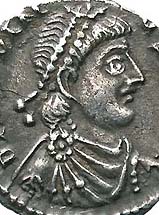 suggested that Roman officials who had previously supported Constantine III also supported Jovinus. This support of Jovinus for Emperor by the Burgundians was an attempt to strengthen their position within the wider Roman Empire. However, the reign of Jovinus was brief, and the Burgundian’s role as imperial power brokers proved a temporary one. Athaulf and his Visigoths eventually killed Jovinus at the behest of Rome in A.D. 413.
Peter Heather has explained that it was common practice for barbarian groups to attempt to strengthen their position within the Empire by supporting rebellion when the opportunity arose. They respected the strength of Rome too much to strike out on their own, in the open, to set up an independent state by directly usurping land from the Roman Empire. In this, the barbarian tribes and their leaders were just one of the multiple players in Late Antique imperial politics, which included various Roman political and ecclesiastical factions. And, as Ralph Mathisen has noted, however, these factions were just as, if not more, involved in the rise and fall of the various “tyrannical” emperors as were the barbarian groups and their kings.
During this time, the Roman imperial claimant Constantine III (A.D. 409-411) had entered the Rhone valley. He encountered certain barbarian tribes, often believed to have been Burgundians and Alamanni. At that time, Constantine made some sort of mutually beneficial agreement with these tribes, which they later violated. Further, it seems both groups, the barbarians and Constantine, continued to operate independently of each other in the region, in a sort of acquiescence of feigned ignorance.
It seems apparent that if the Burgundians did indeed drive the Alamanni out of territory they occupied, then the two groups may also have had a falling out. After Constantine III was killed, Jovinus (A.D. 411-412), a Gallo-Roman in northern Gaul, was raised as emperor with the support of the Burgundians. It has also been suggested that Roman officials who had previously supported Constantine III also supported Jovinus. This support of Jovinus for Emperor by the Burgundians was an attempt to strengthen their position within the wider Roman Empire. However, the reign of Jovinus was brief, and the Burgundian’s role as imperial power brokers proved a temporary one. Athaulf and his Visigoths eventually killed Jovinus at the behest of Rome in A.D. 413.
After the fall of Jovinus, Prosper of Aquitaine wrote that the Burgundians “acquired part of Gaul near the Rhine.” Prior to their support of Jovinus, Constantine III had confirmed the Burgundians in their possession of the land they had seized along the Rhine. The new emperor, Honorius, accepted them as Federates of the Empire (foederati), probably more out of necessity than desire. As such, in A.D. 413, they were established along the Rhine and pledged to guard the empire against its enemies. This was the first Burgundian kingdom in Gaul, under their king, Gundahar.
UP NEXT: The Conversion of the Burgundians
SOURCES:
Geary, The Myth of Nations.
Mathisen, Roman Aristocrats in Barbarian Gaul.
Prosperi Tironis epitoma chronicon, ed. Th. Mommsen, Chronica Minora I, MGH AA 9 (1892), 385-485. trans. A.C. Murray, in From Roman to Merovingian Gaul: A Reader, ed. and trans. Alexander Callander Murray (Orchard Park, NY: Broadview Press, 2000).
L. Schmidt, Geschichte der Wandalen, 1901 in Bury, Later Roman Empire.
Heather, “The Huns...,” The English Historical Review.
Robert Latouche, “Agriculture in the Early Middle Ages,” in The Barbarian Invasions: Catalyst of a New Order, ed. Katherine Fischer Drew (New York: Holt, Rinehart and Winston, 1970).
Musset, Germanic Invasions.
Orosius, Historiae adv. Paganos, edited by Zangemeister (1889) and E.A. Freeman, Western Europe in the Fifth Century (1904) in Bury, Later Roman Empire.
Chronica Gallica A. CCCCLII, ed. Th. Mommsen, Chronica Minor I, MGH AA 9 (1892), 646-62, trans. by A.C. Murray, in Murray, Merovingian Gaul, 81. (hereafter cited as Chronicle of 452).
Prosperi Tironis, in Murray, Merovingian Gaul.
Gregory of Tours, The History of the Franks, trans. with an introduction by Lewis Thorpe (London: Penguin Books, 1974).
Mathisen, Roman Aristocrats.
Mathisen, “Proculus, Patroclus, and Pelagianism: The Gallic Church in the Age of the Tyrants,” in Ecclesiastical Factionalism and Religious Controversy in Fifth-Century Gaul, (Washington, D.C.: The Catholic University Press, 1989).
The Chronicle of Hydatius and the Consularia Constantinopolitana, ed. and trans. Richard W. Burgess (Oxford, 1993), trans. A.C. Murray, in Murray, Merovingian Gaul.
Subscribe to:
Posts (Atom)