Showing posts with label Catholicism. Show all posts

Thursday, October 21, 2010

The Rise and Fall of Sigismund

Upon Gundobad’s death in A.D. 517, his son Sigismund was proclaimed king, while his other son Godomar supported his brother and held court at Geneva. Sigismund had converted to Catholicism, guided by Bishop Avitus of Vienne, probably some time around A.D. 501/502. Lucien Musset ventured that Sigismund was “completely in the hands of Avitus and the Catholic clergy. He looked to the Eastern Emperor as his overlord, and addressed him in almost servile terms.” However, Shanzer and Wood counter that Sigismund’s conversion was probably more a result of a visit to Rome than by any direct influence of Avitus.

Besides, the pope or Avitus were not the only Catholics in Sigismund’s life. There were many in the Burgundian royalty who were also Catholic, most importantly Sigismund’s mother, Caratena. Of course, Sigismund’s cousin, Clotilda, was also Catholic, as was her mother and sister. Shanzer and Wood also add that “[i]n fact it is difficult to find named Burgundian women who were Arian.” However, Avitus did have a close relationship with Sigismund. On more than one occasion, he wrote to Sigismund to express his disappointment at not having seen him over Easter or when Sigismund had been traveling through Vienne. On other occasions he wrote of his concern for the safety of Sigismund while on a military campaign.

Sigismund had probably been elevated to the position of rex, or sub-king, by his father, some time around his conversion. Thus, he was most likely quite an experienced politician by the time his father died and he ascended to the throne. While his father was still alive, he had recognized the precarious position of his kingdom geographically between the Franks and Goths and he sought the aid of the emperor in Byzantium. He wrote to Byzantium to re-assert the status of the Burgundian kingdom as technically a legal territory of the empire, or federated regnum, and to maintain good relations between Constantinople and the Burgundian kingdom (Musset probably derived his assessment of Sigismund from these letters).

In his letters, Sigismund reminded the emperor of the role that Burgundy played as a vital part of the empire in Gaul, and, more importantly, lobbied for an imperial position commensurate with one who led such a vital part of the empire. He was rewarded with the title of patricius as a result of this correspondence. Upon his assumption of the Burgundian throne, he received the more important title of magister militum. These events were noticed by Theodoric, whose own relations with Byzantium had crumbled. He attempted to cut off diplomatic traffic between the two, most of which were letters written by Avitus of Vienne, by not allowing Sigismund's messengers to travel through Italy to Constantinople.

Sigismund had a few important accomplishments. He had built a monastery at Saint-Maurice d’Agaune in A.D. 515 and the monks supported him. He added to the Lex Gundobad. Lyons, and possibly Vienne, had schools of rhetoric and archeologists have traced Latin inscriptions to this period. It was he who, in A.D. 517, had called for the royal synod at Epaon and who also held several provincial synods during his reign.

Unfortunately, the Catholic bishops were disappointed by Sigismund’s actions in a case involving his royal treasurer Stephanus in an incestuous relationship with a woman named Palladia. The murderous palace scandal resulted in a “no-confidence” vote by the Catholic bishops and contributed greatly to erosion of ecclesiastical support for Sigismund. Though a resolution was made, Sigismund would never recapture the same standing among the ecclesiastics that he had once held.

Additionally, the revenue stream, increasingly reliant upon the a shrinking pool of Gallo-Roman landholders who saw no such taxation requirements put upon their exempted Burgundian neighbors, may have been drying up. Musset:

Everywhere, in fact, the fundamental resources of the state continued to be provided by the Roman taxation system, the burden of which rested on the Roman inhabitants, through the medium of a government land survey whose registers continued to be kept more or less up to date; the general exemption from taxes which the barbarian estates enjoyed must have diminished the yield as well as increased the burden.

Thus, while the money supply shrank, the resentment among those contributing to it grew.

Sigismund also had problems within his immediate family. His first wife, the daughter of Theoderic of Italy, had died giving birth to his eldest son Sigeric. According to Gregory of Tours account, Sigismund’s second wife disliked Sigeric and conspired to make Sigismund suspicious of Sigeric’s motives towards his father. She convinced him that Sigeric was conspiring with his grandfather Theoderic to seize Burgundy from Sigismund. Her conniving was successful and Sigismund made plans to have Sigeric murdered.

As the story goes, Sigismund got his son drunk until he passed out and then had two retainers strangle him. He immediately regretted his act as, according to Gregory of Tours, he “threw himself on the dead body and wept most bitterly.” Burgundian outrage at this vicious murder combined with the recent loss of ecclesiastical support proved to be Sigismund’s undoing. He might have survived, despite this internal unrest, had not external factors also contributed to his downfall.

UP NEXT: Godomar, Last King of the Burgundians

SOURCES

Wood, “Kings, Kingdoms and Consent"
Avitus of Vienne.
Musset, Germanic Invasions.
Avitus, Epp. 93 and 94 in Opera, ed. Piper, 1883 in Bury, Roman Empire.
Wolfram, Germanic Peoples.
Wood, The Merovingian Kingdoms.
Wood, “Incest, law and the Bible in sixth-century Gaul."
Gregory of Tours, The History of the Franks.
Marius of Avenches in Murray, Merovingian Gaul.
Kurth, Saint Clotilda.

Friday, July 30, 2010

Christianity in the Burgundian Kingdom

Salvian of Marseille wrote in the 440s that Barbarians are strangers to learning and know nothing unless it is taught to them. Thus, since they were taught heretical, or Arian Christianity, they held that theirs was the true faith and that Catholics were heretical just as the Catholics thought the same of them. This kind of tolerant attitude toward Arian Christians may not have been prevalent, but it may help to explain the tolerance, or at least the lack of antagonism, between the ecclesiastics of each brand of Christianity.

According to Salvian, Roman Catholics and barbarian Arians associated rather freely and probably were more unified by the common aspects of Christianity than they were splintered by dogmatic belief in either being the only true form. In Burgundy, the Roman Catholic Church was treated fairly, probably because the royal house had been divided between Arianism and Catholicism. (Some historians believe the Burgundians went from Catholicism to Arianism and then back again).

It seems that, in general, barbarian rulers kept their Arian bishops close at hand and didn’t appoint Arian bishops to cities, as was done in the Eastern Empire. They resided near him in his capital and performed services for the king and his retinue, but performed few other ecclesiastical functions. Thus, bishops formed a sort of sacred council and they performed special, mostly diplomatic, missions at the request of the king.

Perhaps the barbarian kings were paranoid and sought to keep powerful religious leaders close by to keep an eye on them. Gregory of Tours told the story of how Saint Aprunculus, Bishop of Langres, had become suspicious to the Burgundians because of word of a conspiracy of Catholics in Burgundy with Franks. After the Burgundians put out the order to kill him, Aprunculus “was lowered down from the walls of Dijon” and escaped to Clermont where he was made Bishop.

Ecclesiastics often were involved in plots against their overlords. Ralph Mathisen (“Barbarian Bishops”) wrote of how, when Gundobad captured Vienne, Godegisel fled to an Arian church and was there with an Arian bishop (cum episcopo arriano). Mathisen believed that this hinted that the Burgundians had a patriarch, at least in Vienne, whose loyalty to Godegisel was rewarded by death. Or, writes Mathisen, “perhaps this faithful Arian episcopus was the chief bishop of Godegisel’s sacerdotal college.” Finally, Mathisen showed that, with this one exception, there is little evidence of Burgundian Arian bishops.

Gundobad’s wife, Caratena, was Catholic, and, according to Bishop Avitus of Vienne, her “epitaph suggests that she practiced both sexual renunciation and asceticism.” According to Fortunatus, “she was…the mother of the poor and the advocate of the guilty” and she also “gave proof on the throne of every virtue, concealing beneath a smiling countenance the fasts and austerities with which she subdued her flesh.” For his part, Gundobad was friendly with Avitus, who often urged him to convert and, according to Justine Davis Randers-Pehrson, may have at least partially succeeded in bringing Gundobad into the flock.

Randers-Pehrson noted that Avitus’ letter to Clovis congratulating him on his baptism must have had to have passed through the hands of Gundobad for approval, “in a way it was addressed more to him than to Clovis.” Avitus complimented Clovis for recognizing the true religion, unlike other barbarian rulers, and for breaking with tradition to do so. The implication being that any who used tradition as an excuse to hold onto heretical religion no longer had an excuse. According to Randers-Pehrson, “this argument was not lost on Gundobad, who had long wrestled earnestly with the problem and with his conscience.”

Further, Edward James explained that the process of royal conversion had at least three steps. First, the intellectual conversion whereby Christ is accepted; second the public announcement of the acceptance, and third the formal baptism ceremony and acceptance into the Christian community. According to Gregory of Tours, Gundobad reached the first stage but didn’t dare take the second for fear of reprisal among the Burgundians.

Though nominally an Arian and attended to by Arian bishops, Gundobad had a fertile mind and was able to intelligently argue theology with Avitus. He also encouraged debate between Avitus and his Arian bishops.

Burgundian Arianism seemed to be based on strict adherence to a literal interpretation of the Latin Bible. This literal familiarity with the Bible was an advantage for Gundobad and his bishops, who proved to be more adept than Avitus in citing specific scriptural passages. Avitus made at least one mistaken identification of a biblical excerpt during a debate with the Arians, though he may have been citing from memory rather than relying on a direct reference.

Despite their theological differences, Gundobad did respect Avitus and asked him to write his ‘Against the Eutychian Heresy’ after the Trishagion riots in Constantinople in A.D. 511. This illustrated both the scope of his religious inquisitiveness and that he was politically astute enough to want to be on the “right” side of a religious controversy.

Avitus was in line with the orthodox view evolving during his era and was a strong defender of the pope, whose actions he felt only God could ultimately judge. Avitus viewed the controversy surrounding Symmachus and the Laurentian schism as damaging to Catholicism as a whole, and was especially wary of the considerable strength of Arianism among the barbarian kingdoms.

In this, as in nearly all other theological writings that passed before the eyes of Gundobad, Avitus wrote on theology in hopes of bringing the Burgundians around. To these constant entreaties, Gundobad once replied that he couldn’t worship the Holy Trinity. Avitus assured Gundobad that he could avert attack, possibly from Clovis and his recently converted Franks, if he simply converted. Gundobad’s theological assignment to Avitus prompted Gregory of Tours to believe that Gundobad did eventually convert to Catholic Christianity.

There were instances that seem to indicate that the Burgundians may have encouraged, rather than merely tolerated, Catholicism. Notably, the Catholic bishops of the Burgundian kingdom met at Epaon in A.D. 517, under Avitus, and produced an influential list of canons that served as a basis for laws regarding incest. These included prohibitions against marrying your brother’s widow, deceased wife’s sister, mother-in-law, cousin or child of a cousin, uncle’s widow and stepdaughter.

A pamphlet written by Avitus in A.D. 517, “On Not Assimilating Basilicas of the Heretics,” provided additional information regarding the Burgundian Arian church. It was written in response to the fact that Gundobad’s son Sigismund had been converted to Catholicism. Avitus had been asked if churches and basilicas of the Arians were to also be converted. Avitus asked if the king had consulted with his Arian bishops and made it clear that the conversion of the king did not mean the conversion of the people. As such, the Arian religion continued to be practiced in Burgundy. Interestingly, Gundobad took much more than a philosophical interest in the Catholic church. In A.D. 499, he helped Avitus secure papal recognition making the Bishop of Vienne the primary church authority in Gaul over the bishop of Arles (held by the Goths).

In lands where the ruling class followed their teachings, Arian bishops seemed content and did not actively proselytize among the provincials. Lucien Musset (Germanic Invasions) postulated that “the reason for this was probably the intellectual inferiority of the Arian hierarchy, which was badly equipped for controversy and incapable of contemplating systematic missionary activity.” Danuta Shanzer and Ian Wood (Avitus of Vienne) observed that, while the Arian bishops under Gundobad engaged in a theological debate with Avitus, their penchant for being able to memorize and cite specific biblical passages did not necessarily indicate any ability to ponder deeper theological questions.

This willingness to allow Catholicism to spread and flourish within the barbarian kingdoms made Arianism less attractive and, ironically, ended a period of dynamic theological thought in Gaul. With no intellectual opponent, Gallo-Roman Orthodox Christian writers lost their rhetorical abilities and became more dogmatic in their theology as they relied on others, especially Augustine, to establish a new “theological uniformity,” according to Shanzer and Wood.

The belief that the Burgundians were mostly Arian seems to be an overstated one. Clotilda was a Catholic, as were her sister, and her aunt Caretena. Sidonius indicated that Chilperic I and his wife were friendly with Patiens. The only evidence of an Arian church was during the reign of Gundobad, in which he killed his brother, Godigisil. Yet, again, at this time Clotilda and her sister, and later their cousin Sigismund, were Catholic. As for Gundobad, Ian Wood (The Merovingian Kingdoms) theorizes that Gundobad may have acquired his Arianism during his younger years in Rome, through his relationship with his uncle Ricimer. With the exception of Gundobad, then, nearly every member of the Burgundian royal family seems to have been a Catholic.

UP NEXT: The Rise and Fall of Sigismund

SOURCES:

Salvian in Murray, Merovingian Gaul.
Ralph Whitney Mathisen, “Barbarian Bishops and the Churches ‘in Barbaricis Gentibus’ During Late Antiquity,” Speculum 72, no.3 (1997).
Goffart, “Rome, Constantinople, and the Barbarians.”
Dill, Roman Society.
Gregory of Tours, The History of the Franks.
Avitus of Vienne.
Kurth, Saint Clotilda.
Leblant, Inscriptions Chretiennes de la Gaule, Vol. I., 70, no. 31, in Kurth, Saint Clotilda.
Randers-Pehrson, Barbarians and Romans.
Hen, Culture and Religion.
Ian Wood, “Incest, law and the Bible in sixth-century Gaul,” Early Medieval Europe 7, no.3 (1998).
De basilicas haereticorum non recipiendis, Epistulae 7 (MGH AA 6/2:35 – 39) in Mathisen, “Barbarian Bishops.”
Marius Aventicensis, Chronica s.a. 523, ed. Theodor Mommsen, (MGH AA 11:225-39) in Mathisen, “Barbarian Bishops.”
Wolfram, Germanic Peoples.
Musset, Germanic Invasions.

Tuesday, April 27, 2010

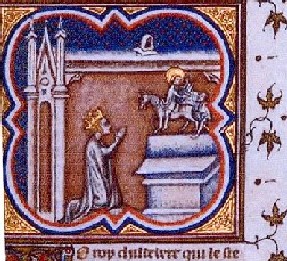
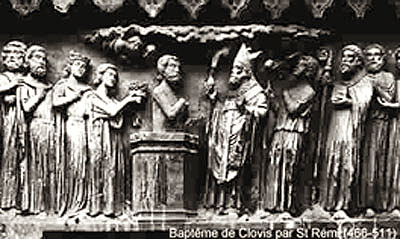
Clotilda, Clovis and the Conversion

Godefroid Kurth (Saint Clotilda) believed that the relationship of Clovis and Clotilda must have encouraged marital fidelity. There is no evidence that Clovis begat any illegitimate offspring after their marriage. No illegitimate heir surfaced in the years of conflict between the sons of Clovis, which tends to support and confirm that Theuderic was Clovis’s only illegitimate son. Evidence of husbandly accommodation also is provided by his forbearance in allowing his sons to be baptized when there appeared to be no advantage to doing so.

Further, according to Kurth, she must have been comfortable with the relationship if she persistently attempted to sway him to Christianity. If their relationship was not so strong, would Clovis have continued to tolerate his wife’s persistent efforts at proselytizing him? Would Clotilda have felt comfortable in her cause if she had doubts as to the disposition of her husband’s feelings toward her? Writes Kurth: “It is obvious that she must have enjoyed considerable ascendancy over his mind in order to have repeatedly urged so great a sacrifice without fear of violent refusal.”

While there has been much written about Clovis’s battlefield epiphany, Clotilda undoubtedly laid the groundwork for his conversion. Championing Clotilda's primacy as the prime mover behind Clovis' conversion, Jane Tibbetts Schulenburg (Forgetful of Their Sex) writes, it’s “the ‘Christ of Clotilda’ whom Clovis invokes” and “neither St. [Remigius] nor other members of the official church hierarchy were similarly awarded this type of prominence.” In contrast, Wallace-Hadrill asserted that while Clovis showed goodwill to the Catholic bishops by his marriage to Clotilda, the acute act of his marriage to Clotilda did not prompt his conversion, despite the efforts of his wife and Bishop Remigius. However,Wallace-Hadrill was willing to concede that the groundwork laid by Clotilda and Remigius may have played a key part:

The pattern is familiar. Defeat stares him in the face and his gods have deserted him; his thoughts turn to his wife’s god, to whom he prays in his heart for victory; and victory is his. Like Constantine in a similar predicament, Clovis knows that he must throw in his lot with the new god...The parallel with the battle of the Milvian Bridge does not disprove the later story. His wife and St Remigius were there to remind Clovis of Constantine, if he needed reminding.


On the other hand, as I.N. Wood (The Merovingian Kingdoms) noted that Avitus made no mention of Clotilda’s role in converting Clovis, nor of a battlefield conversion, but credits Clovis for finding his own way.

Regardless of who deserves credit for converting the Frankish King, there was a risk for Clovis in deciding to convert. The majority of the Franks were pagan or Arian and for Clovis to maintain his power over the Franks, his bodyguard would also have agreed to convert or they would have disbanded and eliminated Clovis’s power base. Clovis had doubts as to whether they would join him and called a meeting to inform them of his intention. They all agreed to be converted with their king. Thus, around 3,000 of his warriors*, (though this may be an exaggerated number) were baptized with him.


Wallace-Hadrill theorized that Clovis’s conversion wasn’t “total” but more the acceptance of another god “to his people’s pantheon, perhaps in a commanding position.” Still, this is different than baptism and “officially” accepting no other gods but the Christian. This last was probably made easier by the “pantheon” of saints.

But even adhesion calls for conviction of right, and it is no belittlement of Clovis’ act to term it a political decision, taken after weighing Frankish pagan conservatism against the assured approval of the Gallo-Romans.

Perhaps the Gallo-Roman episcopate had finally demanded conversion, or Clovis had thought that the Empire would actively support him against the Goths. Finally, as Wallace-Hadrill points out, “Without Tolbiac [the battle with the Alamans], the proof would have been lacking that the Christian god gave victory over other Germans.” Tolbiac was, to use a contemporary term, the tipping point.


*Kurth believed that the average Frank cared not what the religion of his ruler was, but this was not so for the bodyguard, which was “bound to the king by a pledge of honour, was associated in all his acts and shared in his good and evil forturnes…they shared in all his personal interests, in his friendships and enmities, and his Gods were their Gods. What would become of this intimate communion of views and sentiments when Clovis passed from the service of Wodin to the service of Christ?”


UP NEXT: Clotilda's Political Influence

SOURCES:

Godefroid Kurth, Saint Clotilda.
Jane Tibbetts Schulenburg, Forgetful of Their Sex.
J.M. Wallace-Hadrill, The Long-Haired Kings.
Ian Wood, The Merovingian Kingdoms.
Justine Davis Randers-Pehrson, Barbarians and Romans.
J.B. Bury, Invasion of Europe.
Samuel Dill, Roman Society.
Jeremiah O’Sullivan and John F. Burns, Medieval Europe (New York: F.S. Crofts & Co., 1943).

Thursday, June 18, 2009

The Christian Conversion of the Burgundians

By A.D. 417, the historian Orosius wrote, the Burgundians, a “strong and destructive nation,” had accepted the Catholic faith and “live kindly, gentle, and harmless lives, not, as it were, with the Gauls as their subjects, but really as their Christian brothers.” Additionally, Orosius wrote that:

The barbarians, detesting their swords, turned to their ploughs and now cherish the Romans as comrades and friends, so that now there may be found among them certain Romans who prefer poverty with freedom among the barbarians than paying tribute with anxiety among the Romans . . . throughout the East and the West the churches of Christ were replete with Huns, Suevi, Vandals, and Burgundians.

Despite Orosius’s contention, it is not known exactly when or how the Burgundians converted to Christianity. In his essay "Christianity and the Northern Barbarians," E.A. Thompson explained that Orosius’ statement that the Burgundians were converted to Catholicism by A.D. 417 "is generally discounted and may be dismissed" and that, no matter how the Germans were converted, the actions of Roman missionaries played only a very small part. Thompson concluded that, although many Catholic bishops worked among the Germans when they entered the Empire as foederati, they were not converted at this time. (NOTE: To clarify, I use the term "Catholic" to explicitly mean Orthodox Christianity or Roman Catholicism, "Arian" to explicitly mean heretical Arian Christianity, and "Christianity" as a more general term).

Barbarian warriors serving in the Roman army may have brought Christianity back to their tribes with them. Additionally, the Christian hostages held by the barbarians were probably the most influential force in their conversion. Paul Lacroix, in Science and Literature in the Middle Ages and the Renaissance, explained that by the end of the fourth century, it was common for Christian churches and monasteries to open their doors to the sick. (The first leper houses were usually built near churches). As such, there was an association between Christians and healing, who saw to "[t]he wants both of the body and soul." Thus, Christians were able to leverage their healing expertise (more likely in a passive, rather than an evangelical manner) as a way to expose their pagan neighbors to the faith.

Another way that Christianity entered the barbarian world was through commerce and trade. Missionaries traveled the trade routes where they often persuaded local chieftains, usually with a few gifts, to allow them to preach in the village without repercussions against either themselves or any new barbarian converts. The most successful would secure permission to build a church and thus help to ensure that the barbarians would continue to be exposed to Christianity. Often, these missionaries were supported by not only the Church, but also the emperor who saw political opportunity in religious conversion. Yet, all of these instances were scattered and uncommon. The first serious, or at least well-documented, attempt at proselytizing amongst the Germans did not occur until the middle of the fourth century, when Ulfilas was sent to preach in the Goth lands.

Ulfilas, though descended from a Cappadocian family, had been raised a Goth and sent as a youth to Constantinople as a hostage. In Constantinople he converted to Arian Christianity, was consecrated a bishop at the age of thirty (A.D. 341) and was sent by Eusebius of Nicomedia to proselytize and spread Arian Christianity among the Goths. J.B. Bury held that Ulfilas was sent to preach Arian Christianity to all in the Goth lands. However, an alternative view was put forth by E.A. Thompson, who asserted that Ulfilas was sent to minister only to those Christians already in the Goth lands, such as Roman prisoners or their descendents, and not to convert pagan Goths. As such, Thompson continued:

[T]he Churches of the fourth and fifth centuries delayed for a curiously long time to send bishops to their captive sons and daughters beyond the frontier; and they made little or no organized or planned effort to save the barbarians from the fire everlasting.

Eventually, Ulfilas was forced to leave the Goth lands because of persecution from Goth leaders. However, only some of the Arian Christian Goths followed him to new lands in Moesia, within the borders of the Roman Empire. Other Arian Goths refused to leave and, despite persecution and martyrdom, Arian Christianity gained a foothold among the Goths. Eventually, the other Germanic tribes, including the Burgundians, converted to Arianism.

Ulfilas is best known for both inventing the Gothic alphabet and translating the Bible into Gothic. Equally important was that he was not a Catholic but followed the Arian heresy developed by the bishop Arius of Alexandria in the fourth century. Arians held that neither Jesus nor the Holy Spirit were co-equal with God. Additionally, Jesus had been created by God and was not eternal. This was contrary to the Catholic position that Christ was ‘fully God, fully man,’ that He had always existed and always would and that he had assumed human form to instruct and to suffer and die for humanity.

The Roman Emperor Constantine called the First Council of Nicea in A.D. 325 in an attempt to resolve the conflict and Arianism was condemned, though only temporarily. Under the reign of the Arian Emperor Constantius II Arianism became ascendant though his successor, the pagan emperor Julian (the Apostate), encouraged conflict between Catholics and Arians. The ascension of Valens in A.D. 364 returned Arianism to preeminence in the eyes of the empire and it was during his reign that Ulfilas journeyed to the Goth lands and planted the seeds of Arianism.

In A.D. 379, the Catholic Theodosius I assumed the reign of the East and he called the First Council of Constantinople in A.D. 381 at which Arianism was outlawed throughout the Roman Empire. Outside it, however, Arianism had taken hold amongst the Germanic tribes, over whom Rome held no power to dictate religious preferences.

Ammianus gave no hint that the Burgundians had abandoned their pagan religion or priesthood when he wrote his history circa A.D. 395, so it must be assumed that they were still pagan upon entering Gaul in A.D. 406. Despite Orosius’ contention that the Burgundians were Catholic by A.D. 417, it seems improbable that a Catholic missionary would have journeyed through Germany and bypassed other tribes to specifically preach to the Burgundians. Additionally, the Gallic Chronicle implies that all of the major Germanic tribes were Arian by A.D. 451.

Most historians have come to believe that the Burgundians actually converted to Arianism sometime prior to A.D. 436, probably when they were settled as foederati in Germania I. This would justify the story told by the historian Socrates that the eastern Burgundians, those who had stayed on the eastern shore of the Rhine when most of their brethren crossed over into Gaul in A.D. 406, had become Christian around A.D. 430. Although the relationship between the two branches of Burgundians remains unknown, it is probably safe to assume that both groups were converted at about the same time.

The question of who converted the Burgundians remains a mystery lost in the mist of time. Some have theorized that a pocket of Roman Arians along the Rhine converted the Burgundians. Yet, it is more likely that a group of Visigothic missionaries preached to and converted the Burgundians some time after A.D. 418 and the founding of the kingdom of Toulouse. Since any such mission at this time would have had to deal with the Huns, any belief that a large group of Visigothic missionaries went traipsing about the Rhine, surrounded by Huns, is probably an exaggeration. This does not exclude the possibility that a smaller group of Visigothic missionaries could have performed the task.

Most of the conversions were more likely the result of a slow, religious osmosis. By settling in Roman lands, surrounded by Romans, Germans were exposed to Christianity. Nonetheless, a people that linked riches, success and the like to their religion could not help but recognize the benefit of praying to the god of their prosperous neighbors. “The move into a new economic and social world was necessarily followed by a move into a new spiritual world.” Though the Burgundians adopted Arian Christianity, it was still to the Christian God that they prayed and from whom they expected to reap the benefit. James C. Russell showed that, from the beginning, in A.D. 376, when the Goths negotiated with the Arian Christian Emperor of the Eastern Empire Valens to enter imperial lands, religion was used as a political tool. According to Russell, it was a way "in which political leaders vouched for their subjects" and it also showed that Roman culture was associated with Christianity. In other words, one could not be Roman and not be a Christian.

That the majority of the Germanic tribes followed heretical Arianism was probably not an accident. As it had fallen out of favor within the empire, it had increased its influence among the Germanic people outside of the empire. In the case of the Visigoths under Theodosius, the barbarians preferred the decentralized, mostly locally governed Arian Christianity over the organized and centrally governed Catholic faith, which they believed would intrude upon their traditions and tend to weaken their social identity. So, while the barbarians adjusted to, even mimiced, the Roman lifestyle, they did not completely embrace Roman culture. The same attitude has been ascribed to the Burgundians. By adhering to what was regarded as a heretical form of Christianity, the already outnumbered Burgundians only increased their isolation amidst a sea of Gallo-Roman Christians.

Any bonds, be they genealogical or religious, that the Burgundians felt with their Gallo-Roman neighbors were not strong enough to prevent the Gallo-Romans from complaining of Burgundian territorial encroachment. By about A.D. 435, the Burgundians had made many attempts to expand their kingdom by invading the province of Upper Belgica, apparently in the belief that Rome had either weakened or was distracted elsewhere. It was unfortunate for them, at the time, the Roman general in Gaul was Aetius, an extremely capable man.

UP NEXT: Aetius and the Fall of the First Burgundian Kingdom

SOURCES:
Orosius, Seven Books of History.
E.A. Thompson, “Christianity and the Northern Barbarians,” in The Conflict Between Paganism and Christianity in the Fourth Century, ed. Arnaldo Momigliano (London: Oxford University Press, 1963).
Paul Lacroix, Science and Literature in the Middle Ages and the Renaissance (New York: Frederick Unger Publishing Co., 1878).
Bury, Invasion of Europe.
C. Warren Hollister, Medieval Europe: A Short History, 8th ed. (New York: McGraw-Hill, 1998), 19-20.
Roger Collins, Early Medieval Europe, 300-1000, 2d ed. (New York: Palgrave, 1999).
Chronicle of 452.
Otto Maenchen-Helfen, The World of the Huns, (Berkeley: University of California Press, 1973).
Wolfram, Germanic Peoples.
Musset, Germanic Invasions.
Socrates, 7.30.3, Chronica Minora, ii. 491, in Thompson, “Christianity and the Northern Barbarians.”
James C. Russell, The Germanization of Early Medieval Christianity: A Sociohistorical Approach to Religious Transformation (New York: Oxford University Press, 1994).
E.A. Thompson, The Visigoths in the Time of Ulfila (Oxford: Clarendon Press, 1966) in Russell, The Germanization of Early Medieval Christianity.
Pierre Riche, Education and Culture in the Barbarian West: From the Sixth Through the Eighth Century, trans. John J. Contreni, with a foreword by Richard E. Sullivan (Columbia: University of South Carolina Press, 1976), 218-19, in Russell, The Germanization of Early Medieval Christianity.
E.A. Thompson, A History of Attila and the Huns (London: Oxford University Press, 1948; reprint, Westport, Conn.: Greenwood Press, 1975).